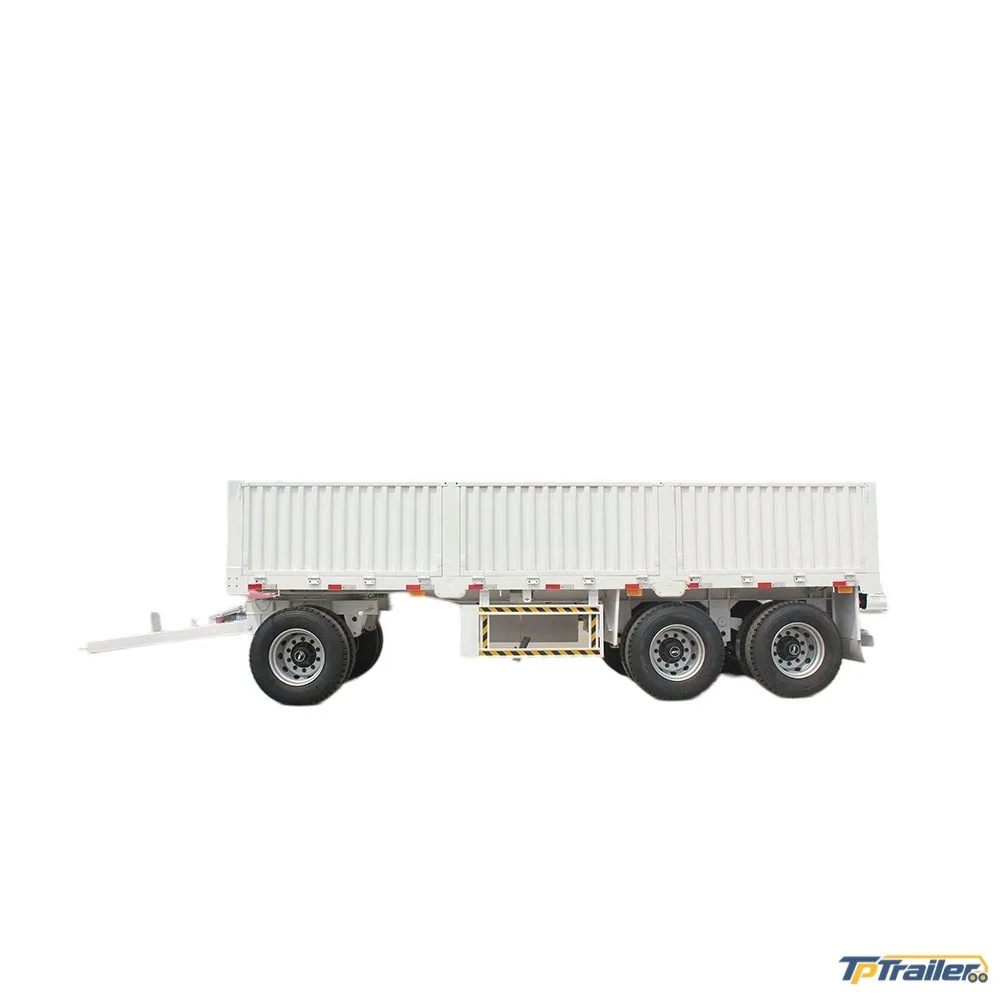
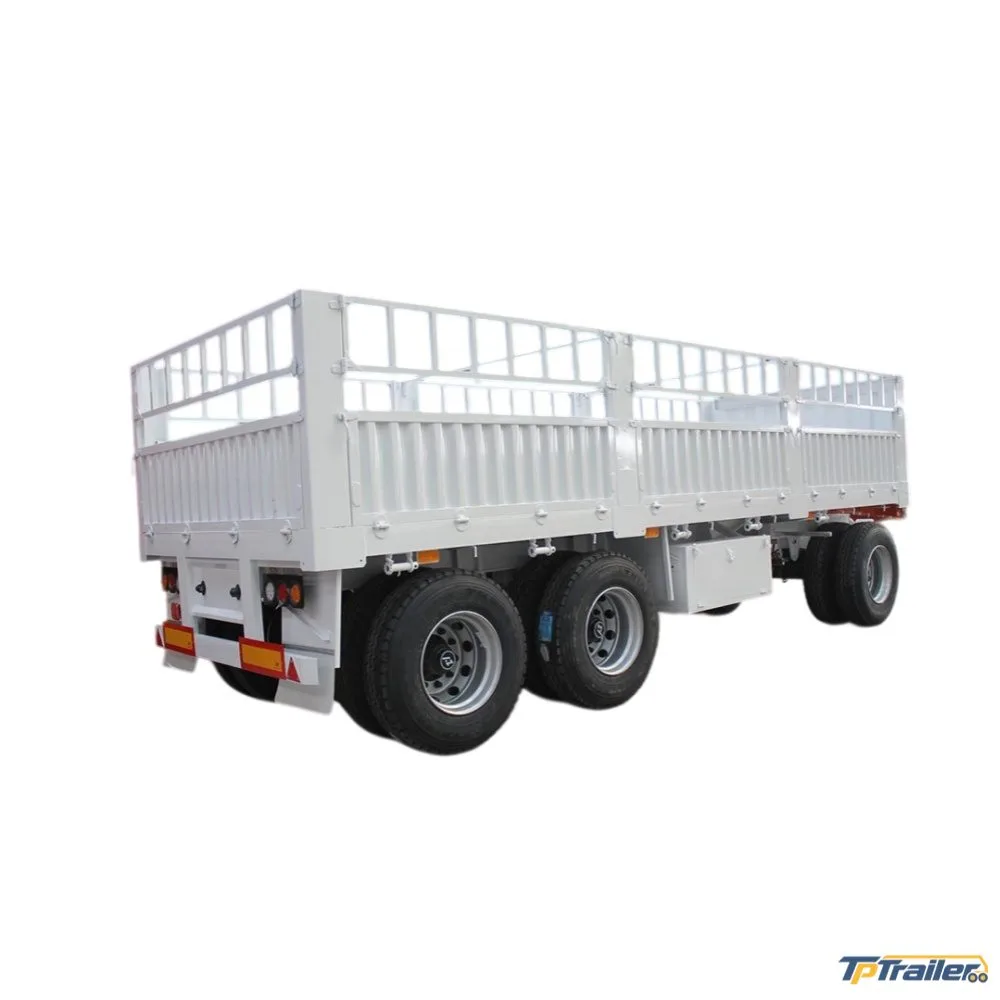
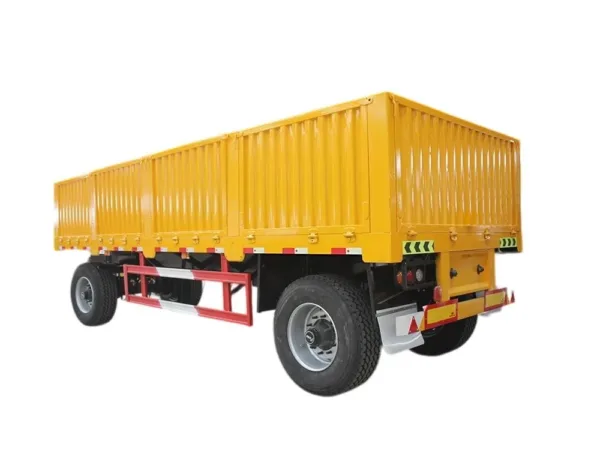
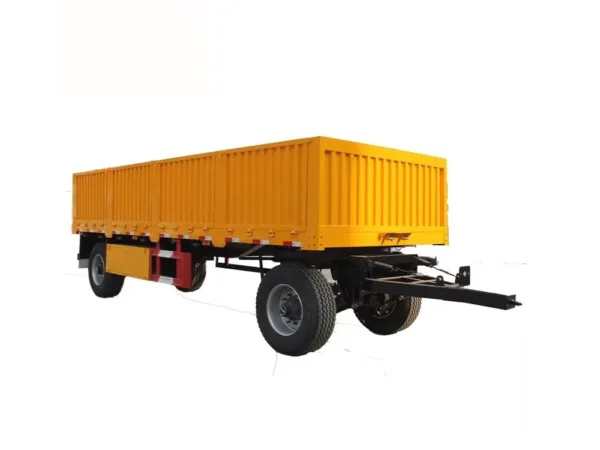
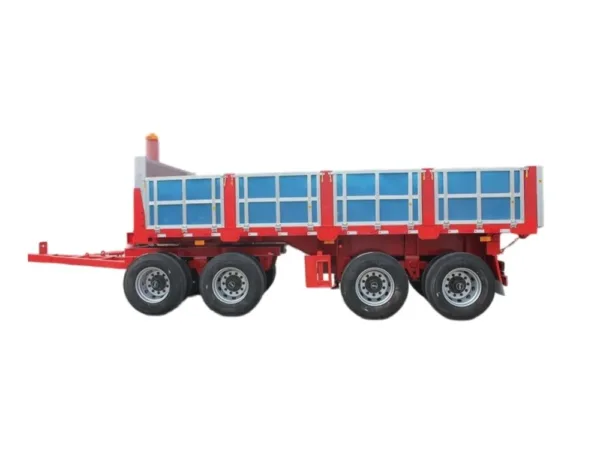
3 Axle Draw Bar Side Dump Semi-Trailer 40-100 Tons
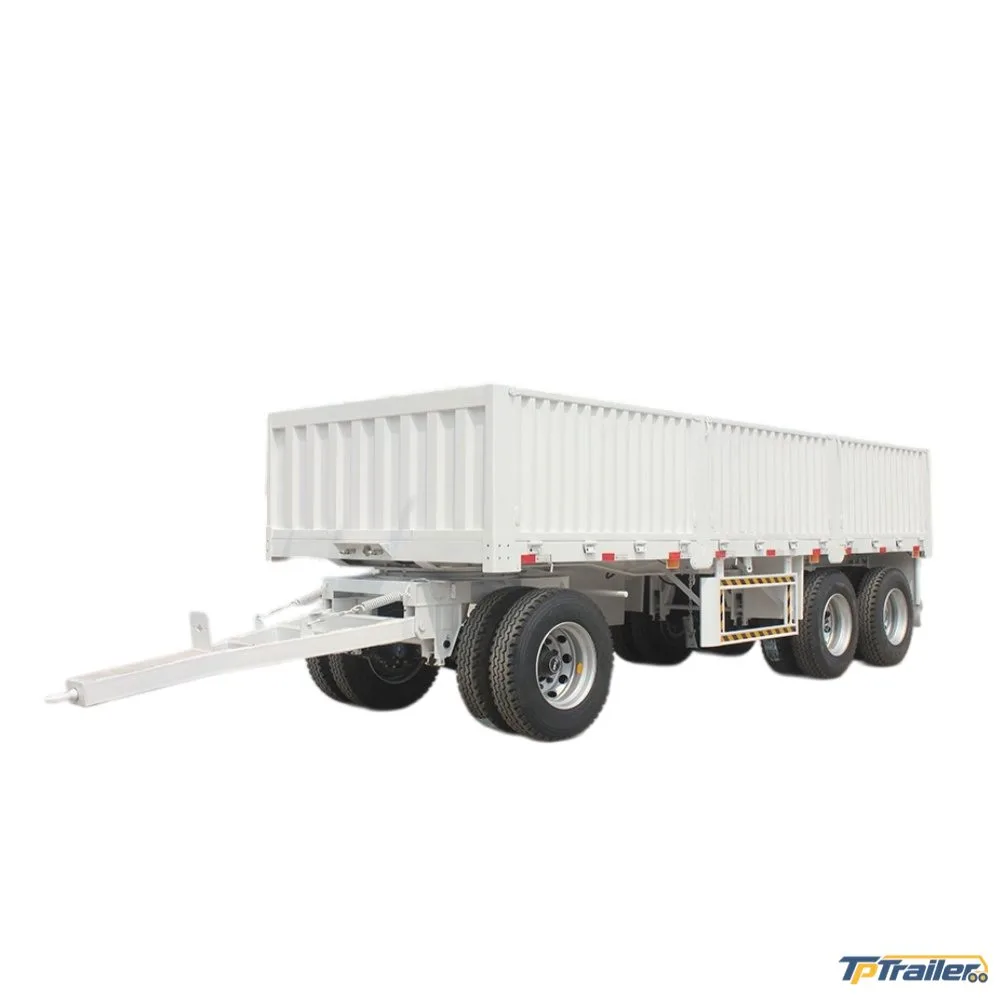
This Full Trailer 3 axle side dump semi-trailer handles loads from 30,000 KG up to 100 tons, giving bulk haulage fleets a high-capacity tipping platform.
>30000 KG 3
FOB Reference PriceUS$8,800-9,900Final price confirmed by inquiry
Certifications
ISO 9001
Key Features
3 axle draw bar side dump configuration for bulk material haulage
Rated for 40-100 tons working range as stated in the product data
30000 KG load capacity for heavy-duty tipping cycles
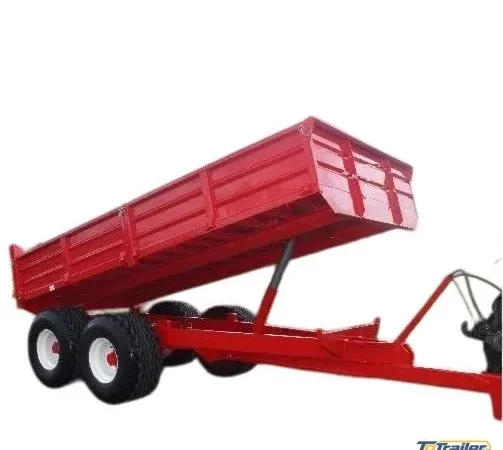
Side dump design discharges to the side of the trailer
Full trailer setup pairs with a draw bar hitch
Built for fleet operators and high-cycle tipping work
Full Trailer is the working name for a draw bar side dump semi-trailer built for farms and yards that need to tip loads sideways instead of backwards. It is a three-axle unit with a draw bar coupling, sold as a complete truck trailer for operators who haul grain, silage, soil, sand and manure on their own land and on local roads. The single strongest reason to choose it is the side tip: the body discharges to the left or right of the draw bar line, so the load lands beside the machine rather than behind it.
Table of Contents
That keeps the towing vehicle clear of the heap and lets one operator spread a load along a feed passage, a field headland or a stockpile edge without reversing into the tip point. It suits mixed fleets that want one trailer to do several jobs.
Why It Works On Site
Side discharge keeps the towing vehicle out of the heap. Because the body tips to the side, the tractor or truck stays on firm ground while the load falls away from the draw bar line. That matters on narrow lanes, feed passages and field edges where there is no room to reverse and tip behind the machine. A Full Trailer set up this way turns a two-person job into a one-person job on most sites.
A three-axle running gear spreads the load. Three axles under one body share the weight across more tyres and more ground contact than a single-axle unit. On soft field entrances, gateways and unmade yard surfaces that spread reduces rutting and keeps the trailer tracking straight. The same layout gives the Full Trailer steadier road manners when it is towed loaded on local routes between fields and stores.
The draw bar coupling suits existing fleet tractors. A draw bar trailer hitches to a standard drawbar rather than a fifth wheel, so it works with the tractors and trucks already on the farm. There is no need for a dedicated prime mover. That is the practical reason many buyers pick a Full Trailer over a gooseneck or fifth-wheel design: it fits the equipment they already run.
The stated load capacity of 30000 KG sets the working cycle. That figure defines how much can be carried per trip and therefore how many trips a job takes. Knowing the number lets an operator plan loads against the harvester output, the silage clamp or the daily feed requirement. It also tells the buyer which tractors and tyres are needed to move the Full Trailer safely when it is full.
One body handles bulk and loose cargo. Grain, sand, soil, silage and manure all behave differently, but a side dump body takes them all without a change of equipment. The operator loads from the top and discharges to the side, so the same Full Trailer can move a harvest load in the morning and a soil load in the afternoon. That flexibility is what keeps a small fleet productive.
Simple steel body and tipping gear are easy to maintain. Fewer moving parts than a powered conveyor or a walking floor means less to service and fewer stoppages. The tipping ram and body are the main wear points, and both can be inspected from ground level. For a farm trailer that works every day, that simplicity is a real cost saving over a season.
Where It Is Used
The most common job for a Full Trailer of this type is moving bulk farm material from field to store. Grain comes off the combine and goes straight into the body, then tips to the side into a pit, a shed or a waiting truck at the yard. Silage and haylage follow the same route, loaded at the clamp face or in the field and discharged along a feed passage.
Soil, sand and gravel move the other way, from a stockpile to a building site or a gateway that needs filling. Because the body tips sideways, the load can be placed along a wall, a fence line or a feed rail without the towing vehicle driving over the heap. That is the pattern most fleet operators recognise: short, repeated runs on farm tracks and local roads, with the tip point close to where the material is needed.
Outside the main harvest cycle, the same Full Trailer earns its place on maintenance and construction work. Manure and bedding are carted from sheds to a muck heap or a spreader, and the side tip lets the operator lay the load in a long line rather than a single heap. Road planings, crushed stone and topsoil are moved for track repairs, yard resurfacing and drainage works, where the ability to drop material exactly along the trench edge saves a second machine.
Contractors and estate fleets also use it for clearing spoil, moving feed between stores and shifting equipment. The routes are usually local, the loads are heavy and the cycle is short, which is exactly the duty a draw bar side dump is built for.
Choosing The Right Spec
Match the load capacity to your heaviest regular cargo. The stated figure is the ceiling for a single trip, so compare it with the densest material you move, not the lightest. A Full Trailer working at or near that limit every day needs a tractor and tyres rated for it. Buyers who regularly run lighter loads can still use the same body and keep margin in reserve.
Decide which side you tip to. Side dump bodies discharge to the left or the right, and the choice depends on how your yard, feed passage or tip point is laid out. Check the space beside the trailer where the load will land, and the direction the towing vehicle will approach from. Getting this right on the order avoids awkward reversing on every cycle with a loaded Full Trailer.
Check the draw bar against your tractors. The coupling height, the drawbar eye and the available power all need to suit the machines you run. A Full Trailer that matches the fleet can be swapped between tractors as work demands. Confirm the hitch arrangement before ordering so the trailer is usable on day one rather than after a modification.
Choose the price tier that fits your buying pattern. The listing offers a single-unit price and a lower unit price at the larger quantity tier. A farm buying one Full Trailer pays the single-unit figure; a dealer or contractor buying several can plan around the quantity tier. Set the order size against your realistic annual workload rather than the headline number alone.
Customisation Before Delivery
Axle count and draw bar layout. The Full Trailer is ordered with the axle configuration that matches your hauling tractor and the loads you carry. Axle count changes how weight is shared along the frame. Settle the count at order confirmation, together with the draw bar arrangement, so the built unit matches your tractor rather than a stock pattern.
Deck length and side height. Deck length and side panel height are chosen against the material you move and the access at your yard. A Full Trailer built for long stock needs different proportions from one built for bulk loads. Both dimensions are fixed at order confirmation, so measure your loading area and your tractor turning space before you commit.
Suspension choice. Suspension type is selected for the road surfaces and the load profile you run. A Full Trailer working mostly on farm tracks is specified differently from one on sealed roads. State your typical route at order confirmation. The suspension is then matched to the axle set and the frame, not added afterwards.
Tyres and wheels. Tyre size and wheel fitment are agreed with the rest of the running gear. The Full Trailer must roll on tyres you can replace locally, so tell us what is available in your market. Tyre and wheel choice is locked at order confirmation and carried through to the axle specification.
Finish and colour. Colour and finish are chosen last, after the structure is fixed. Paint and coating selection affects how the Full Trailer resists weather and farm chemistry over the years. Confirm the colour at order confirmation. Finish is applied to the agreed build, so it follows the specification rather than leading it.
Fitting And Installation
On arrival, the buyer has to match the Full Trailer to the towing tractor. Check the draw bar eye and the hitch on the tractor first. Confirm the mounting points line up and that the coupling height leaves the deck level when loaded. Check the tube size on any hydraulic or pneumatic line against the tractor outlets. Confirm hose routing clears the draw bar through a full turn. A Full Trailer that couples cleanly on day one stays coupled. Where the input gives no fitment data, a fitment drawing is confirmed at quotation instead of assumed.
A wrong size is expensive in a way that is easy to underestimate. A Full Trailer that will not couple is a trailer that sits idle while your season moves on. Downtime on a farm does not wait for a replacement part. A mismatched tube size or a hose that rubs through means the unit is parked at the busiest moment. The cost is not the part; it is the loads that do not move. Confirm the fitment drawing before the unit is built, and the Full Trailer arrives ready to work.
Service Life And Maintenance
Tyres and wheel bearings. Tyres and wheel bearings wear first on any Full Trailer, because they carry every load and every kilometre. The operator should inspect tread, sidewall condition and bearing play before each season. Heat at the hub after a run tells you more than a visual check. Keeping tyres at the correct pressure protects the bearings and extends the interval between replacements.
Brake and air line condition. Brake adjustment and air line condition decide how the Full Trailer behaves when loaded. Inspect lines for rubbing, cracking and chafing at the routing points. Check couplings for secure engagement. A Full Trailer that brakes evenly puts less stress on the frame and the draw bar. Replace worn lines rather than patching them, and record what was changed.
Draw bar and coupling. The draw bar and coupling take continuous cyclic load, so they deserve a scheduled look. Inspect the eye for wear, the mounting bolts for looseness and the frame welds around the draw bar for cracks. A Full Trailer used on rough ground should be checked more often. Any elongation at the eye is a reason to stop and replace, not to continue.
Frame, deck and side panels. The frame and deck carry the load, and the side panels contain it. Inspect for cracks at welded joints, deformation in the deck and wear at the hinge points of the side dump. Wash off corrosive material after handling it. The coating choice made at order protects these surfaces, and a sound coating is what keeps the inspection interval long.
Fasteners and pivot points. Fasteners loosen with vibration, and pivot points dry out. Walk the Full Trailer before each season and check the structural bolts to the specified torque. Grease the pivot points of the tipping mechanism. A Full Trailer kept on a simple checklist lasts longer than one inspected only after something fails. Note every finding so the next inspection has a baseline.
Packing And Container Loading
Each Full Trailer is prepared for sea freight with the running gear and draw bar secured so nothing shifts in transit. Surfaces are protected against salt air and handling marks before the unit is moved to the port. Because the trailer is a long, rigid assembly, it travels as a single unit rather than being broken down into loose sections. Buyers should ask the supplier to confirm the exact protection method in writing before shipment. That written confirmation is the only reliable record if damage is found later. The Full Trailer should be inspected against that record on arrival, not after the unit has been towed away from the dock.
Nesting and stacking options depend on the frame type and axle configuration, so the supplier must confirm whether units can be stacked for your order. For a Full Trailer, stacking reduces container space per unit but can increase the risk of frame contact and paint damage. Buyers should request a loading plan that shows how many units fit per container and where the lifting points sit. On arrival, verify the frame is straight, the axles turn freely and the draw bar shows no bending. Check the paint at contact points first, since that is where handling damage appears. Photograph everything before signing the delivery receipt.
Common Mistakes Buyers Make
Assuming a standard draw bar fits every tractor. The hitch height and draw bar geometry vary between towing vehicles, and a mismatch means the Full Trailer cannot be coupled safely. The single check is to measure your tractor’s hitch height and confirm it against the supplier’s drawing before ordering.
Ordering the wrong axle count for the load. Buyers pick an axle count by habit rather than by the load capacity they actually need, which leaves the trailer under-specified or over-specified. The check is to state your intended payload and confirm the axle count and load capacity together in the quotation.
Ignoring container height limits. A Full Trailer loaded for export must fit the container opening once packed, and buyers rarely confirm this in advance. The check is to request the packed dimensions and compare them with the container’s internal height before the order is placed.
Skipping the loading plan. Without a plan, units are loaded in the order they are finished, and the last unit is often the hardest to secure. The check is to approve a written loading plan that shows unit positions, lifting points and tie-down locations.
Not recording condition on arrival. Buyers sign the delivery receipt before inspecting the Full Trailer, which weakens any later claim. The check is to inspect the frame, axles and paint against the supplier’s packing record and photograph each point before signing.
Buyer Questions
Can the trailer be shipped in a standard container?
Container fit depends on the packed dimensions of the Full Trailer and the container type you book. The input does not state packed dimensions, so the loading arrangement must be confirmed at quotation. Ask the supplier for the packed length, width and height, then compare them with the container’s internal measurements. Also confirm how many units fit per container, since that decides your freight cost per unit. Do not assume a single unit fills one container until the supplier confirms the loading plan for your order.
How do I confirm the draw bar matches my tractor?
Send the supplier the hitch height and coupling type of the tractor that will pull the Full Trailer. Ask for a drawing that shows the draw bar length, hitch position and mounting points. Compare that drawing with your tractor’s coupling before you approve production. If the tractor changes later, confirm the new hitch dimensions again rather than assuming the old drawing still applies. This single step prevents the most common reason a new trailer is returned or modified on arrival.
What should I check in the quotation before paying?
Check that the quotation states the axle count, load capacity and draw bar configuration for the Full Trailer you are ordering. Confirm the price tier that applies to your quantity, and ask whether the quoted figure includes packing and loading. Request the packing method and loading plan in writing. The input does not state lead time or certification, so those items must be confirmed at quotation. Keep the approved drawing and quotation together as the reference for the arrival inspection.
To receive a quotation, send the trailer length you need, the number of axles and your order quantity. State your intended load so the load capacity can be confirmed against your use. Include your destination port for packing and loading planning. The supplier will return a written quotation with the configuration and the applicable price tier.
We use cookies to enhance your browsing experience, serve personalized content, and analyze our traffic. By clicking "Accept All", you consent to our use of cookies. Privacy Policy
Cookie Preferences
Required for the website to function properly. Cannot be disabled.
Help us understand how visitors interact with the website (Google Analytics).
Used to deliver personalized ads and measure ad campaign effectiveness.





















Write a Review