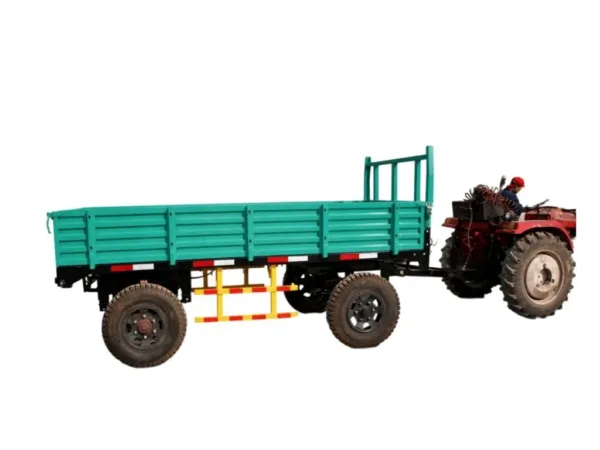
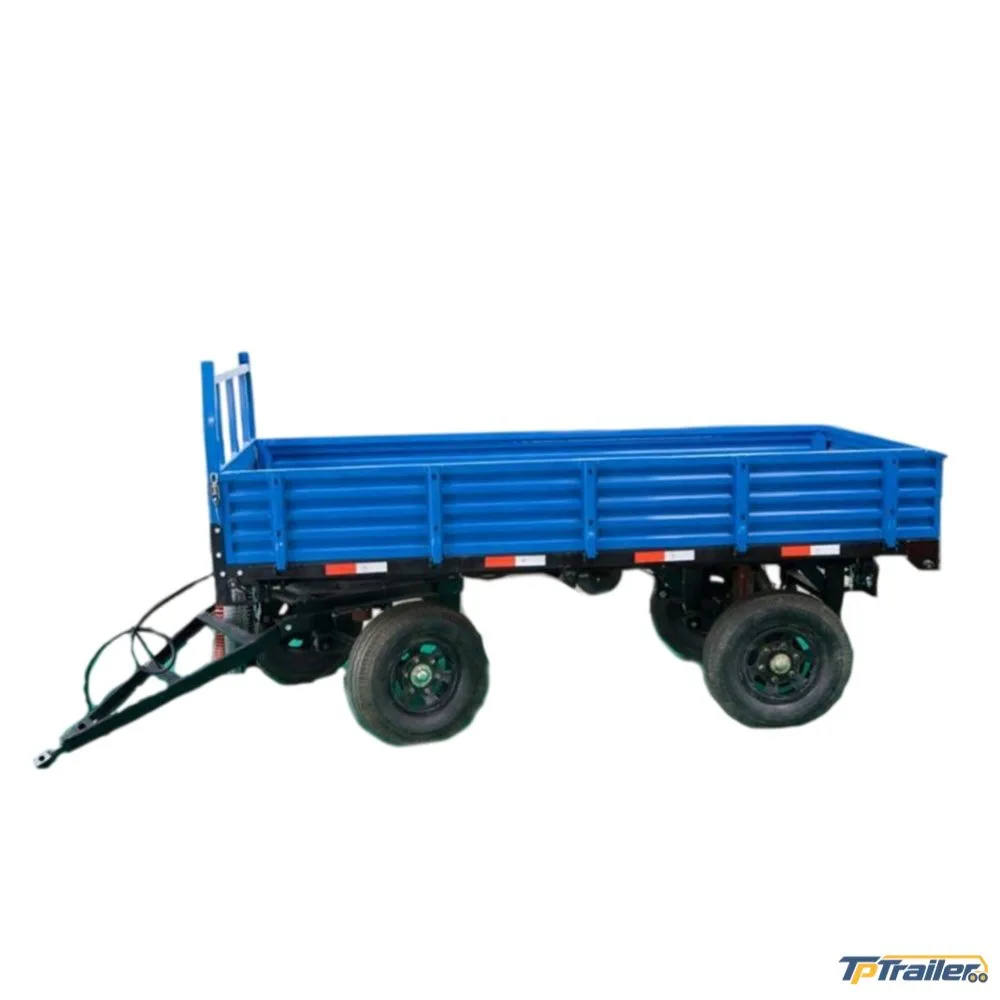
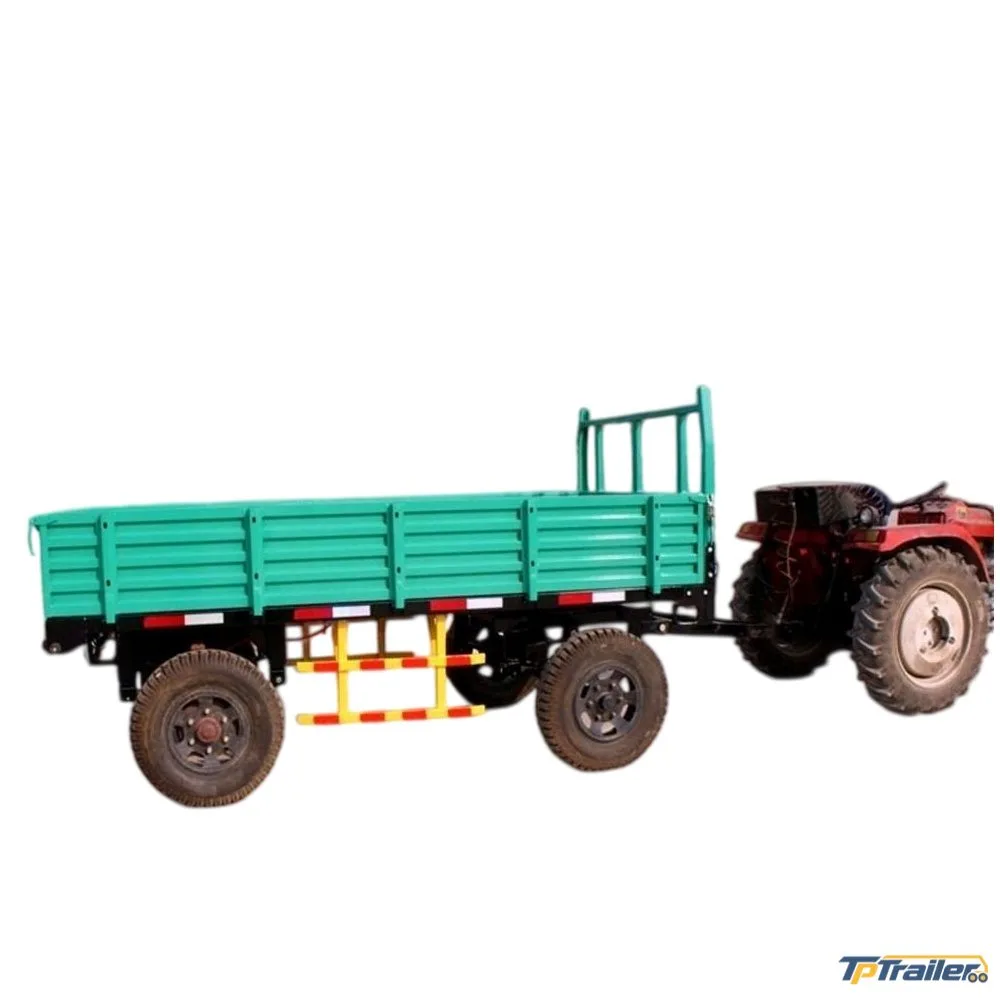
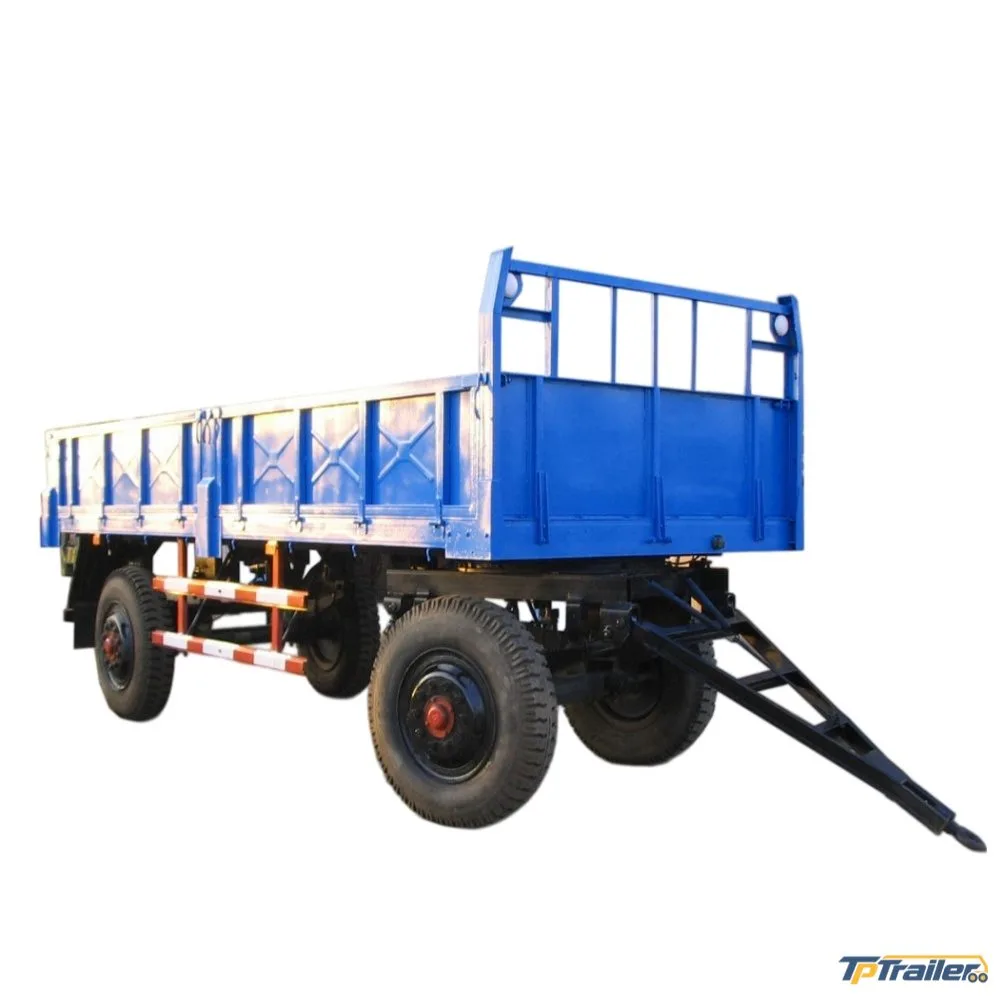
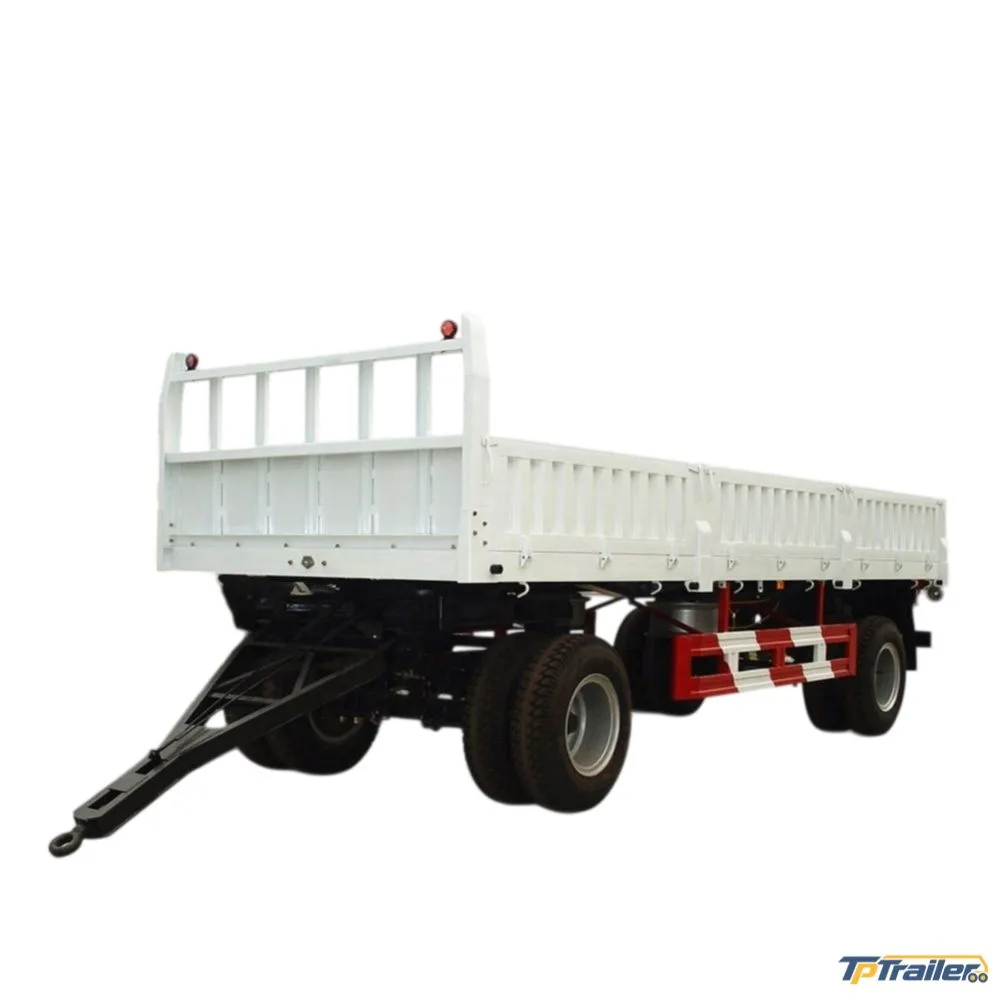
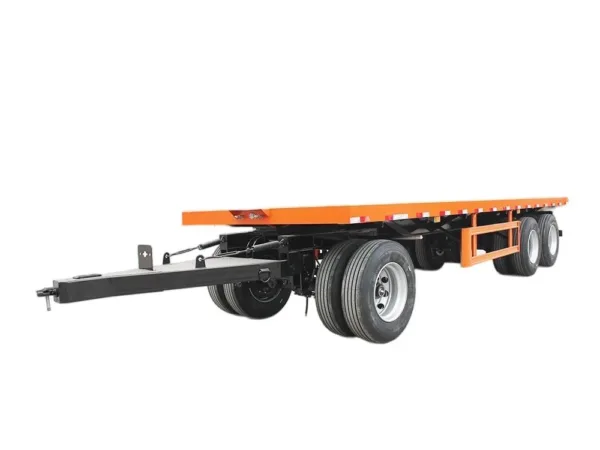
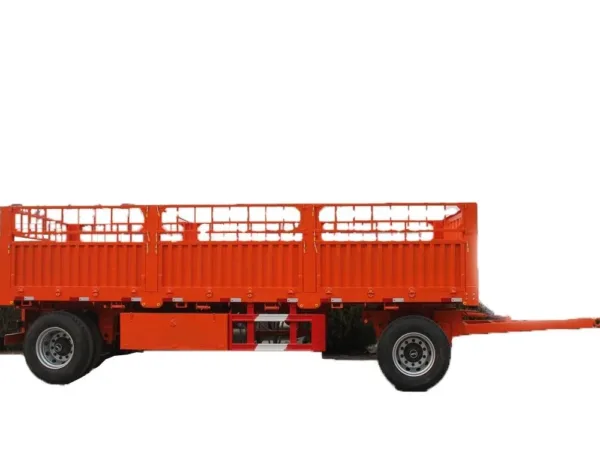
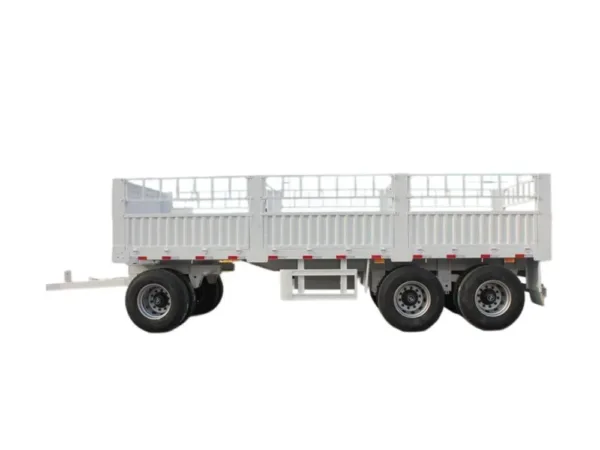
The small farm tractor trailer is a four-wheel tipping unit built for mixed farms and contracting fleets that need one machine to move bulk loads and tip them where they land. It suits operators running compact or utility tractors who want a towable body that loads like a trailer and empties like a tipper. Its strongest advantage is the tipping body on a four-wheel chassis: you can haul a full load from field to yard and discharge it without shovelling or a second machine. The CE certification on the unit gives buyers a documented reference point when checking the trailer against their own market requirements.
Table of Contents
Why It Works On Site
Four wheels carry the load, not the tractor. With the load carried on its own axle set, the small farm tractor trailer keeps weight off the tractor’s rear linkage and hitch. That matters on soft ground and on long runs between field and yard, where a trailed load can otherwise push the tractor around. The towing machine stays stable, steering stays predictable, and the driver is not fighting a load that wants to overtake the tractor on a slope or a wet headland.
Twin axles spread the weight. The two-axle layout shares the load across four contact points, so each wheel presses less into the surface. On pasture, cultivated ground and yard edges that have been softened by rain, that reduces rutting and the risk of bogging down. It also keeps the trailer level when one wheel drops into a furrow, so the load stays put instead of shifting to one side during the run.
The tipping body clears the load in one pass. A tipping body turns unloading into a single operation. Manure, silage, soil, sand and feed drop out under their own weight once the body is raised, so the operator does not need a shovel crew or a second machine to empty the trailer. On a busy day that is the difference between one trip and three, and it keeps the small farm tractor trailer working instead of waiting at the heap.
CE certification supports the paperwork. The CE certificate gives fleet managers and dealers a document to file when the trailer is assessed against local market requirements. It does not replace a site-specific risk assessment, but it means the small farm tractor trailer arrives with a conformity reference rather than as an undocumented import. That shortens the conversation with insurers, inspectors and buyers who ask what the unit is certified to.
Custom dimensions fit existing routes. Because the dimension is customised, the body can be sized to the gateways, lanes and sheds the trailer actually uses. A buyer running narrow field entrances is not forced into a body that clips posts, and a buyer loading from a wide yard can take a larger body without penalty. The small farm tractor trailer then fits the farm layout instead of the layout being rebuilt around the trailer.
Capacity range covers seasonal peaks. The stated capacity range of 3 to 8 ton lets one trailer family serve both routine daily hauling and harvest peaks. A farm that moves modest loads most of the year can specify toward the lower end, while a contractor facing heavy silage or grain weeks can specify higher. The small farm tractor trailer stays matched to the work rather than being oversized for the quiet months.
Where It Is Used
The most common job for a small farm tractor trailer is moving material between the field and the yard. That covers manure and bedding cleared from livestock housing, silage and hay carried from storage to feed lines, and soil or compost shifted during field preparation. On mixed farms the same trailer handles straw bales, bagged feed and fencing materials, so the machine earns its keep across the calendar rather than in one season.
The tipping body is what makes these short, repeated runs efficient: the operator loads at the source, tows a short distance, raises the body and is back at the source without handling the cargo twice. Routes are typically farm tracks, gateways and yard surfaces, which is where the four-wheel layout and twin axles do their best work.
A second set of jobs sits in construction, landscaping and grounds maintenance, where the cargo is heavier and the routes are rougher. A small farm tractor trailer in this role hauls sand, gravel, crushed stone, topsoil and rubble on site roads, service tracks and temporary access routes. Contractors use it to move spoil from a dig to a spoil heap, to ferry paving materials to a working area, and to clear green waste from parks and verges.
The tipping action matters here because these loads are dense and awkward to shovel. The customised dimension also lets the buyer match the body to narrow site access, and the colour choice helps fleets keep units identifiable in a yard. Capacity selection follows the density of the cargo and the length of the run.
Choosing The Right Spec
Match capacity to cargo density. The trailer is offered across a 3 to 8 ton capacity range, and the right point depends on what you haul. Light, bulky cargo such as straw, hay or bedding fills the body long before it reaches a heavy weight, so a lower capacity suits it. Dense cargo such as soil, gravel or wet manure reaches weight quickly, so buyers moving those loads should specify toward the upper part of the range and check the load capacity figure against their tractor.
Use the load capacity figure as the planning number. The stated load capacity of 3T is the figure to plan against when the trailer is specified at that point in the range. Compare it with the weight of a typical full load of your main cargo, not the heaviest load you have ever moved. A small farm tractor trailer working inside its rated load lasts longer and tows more predictably than one pushed to the limit on every trip, especially on slopes and soft ground.
Size the body to your routes. Because the dimension is customised, the body should be sized to the tightest point on the route: gateways, shed doors, lane widths and turning areas. A buyer with narrow access gains more from a compact body than from extra volume that cannot pass. Buyers with open yards and wide tracks can take a larger body and cut the number of trips. The small farm tractor trailer should fit the farm, not the other way round.
Choose colour for fleet management. Colour is supplied as the customer needs, which is a practical choice rather than a cosmetic one. Fleets can keep units in one colour for identification and resale consistency, while mixed-site operators can use colour to separate trailers assigned to different jobs or locations. A small farm tractor trailer that is easy to spot in a yard or at a field edge is easier to track, and the colour choice costs nothing in hauling performance.
Customisation Before Delivery
The axle count is fixed when the order is confirmed, so a buyer who needs a different number of axles should raise it at quotation stage. Each configuration changes how the small farm tractor trailer tracks behind the tractor and how the load is shared across the running gear, so the choice is settled in writing rather than assumed later.
Deck length and body dimensions are built to the buyer’s requirement. Give the dimensions you need for the loads you carry, and the factory works to that drawing. A short deck suits tight yards and narrow lanes; a longer deck carries bulky material. Confirm the figure before production, because the small farm tractor trailer body is not cut to a standard size.
Colour is supplied as the customer needs, matched to the paint reference you supply with the order. Paint choice is agreed at order confirmation together with the rest of the specification, so the small farm tractor trailer arrives in a finish that matches the rest of the fleet and is easy to touch up.
Suspension and tyre specification are agreed at order confirmation, not after the chassis is built. Tell the sales team the ground you work on, the towing tractor and the road speeds you expect, and the small farm tractor trailer is configured to suit. The decision is recorded before production starts.
Payment terms are a 30% deposit with the 70% balance before shipment. Customisation is locked once the deposit is received, so the small farm tractor trailer is built to one agreed specification. Any change after that point is a new order, not an adjustment to the one in progress.
Fitting And Installation
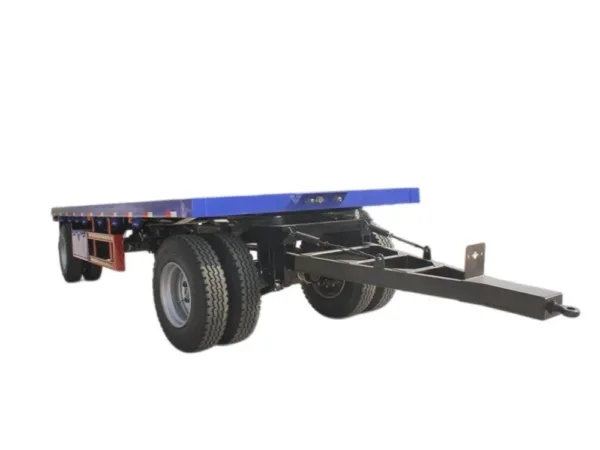
Fitting starts at the drawbar, where the hitch on the small farm tractor trailer has to match the tractor’s linkage or ball coupling. Measure the mounting points on the tractor before the trailer arrives and compare them with the drawing agreed at quotation. Check that the drawbar height lets the trailer sit level when loaded, because a nose-up or nose-down attitude shifts weight onto the wrong axle.
On a tipping body, confirm there is clearance above and behind the trailer for the raised body, and that the hydraulic supply on the tractor matches the tipping ram connection. Where the input gives no fitment data, a fitment drawing is confirmed at quotation rather than assumed from a catalogue. The small farm tractor trailer is a matched implement, so the coupling, the hydraulic hose routing and the electrical connection are checked as one assembly before the first loaded run.
A wrong size costs downtime that a buyer rarely budgets for. If the hitch does not line up, the small farm tractor trailer sits idle while an adapter is sourced or the drawbar is reworked, and the harvest or haulage job it was bought for waits. Hose routing that is too short or badly clipped rubs through on the first season of use, and a mismatch between the tractor’s hydraulics and the tipping ram leaves a loaded body that cannot be raised.
Tyre and axle choices agreed at order confirmation avoid a second problem: a trailer that is too wide for the gate or too heavy for the tractor. Before the first load, walk the small farm tractor trailer and check every fastener, the hose clips and the lights. Confirm the torque values with the supplier where the manual provides them, and keep the fitment drawing with the machine so a replacement part is ordered correctly the first time.
Service Life And Maintenance
The tyres and wheel bearings wear first on any small farm tractor trailer that works on rough ground. Inspect tread depth, sidewall cuts and bearing play before each season, and check wheel nut tightness after the first loaded trips. Keeping tyres at the correct pressure protects the sidewalls and extends the interval between replacements.
The tipping ram and its hydraulic hoses are the next wear point. Look for chafed hose covers, weeping unions and a slow or uneven lift. A small farm tractor trailer that hesitates under a full load is telling the operator to check the oil level and the hose routing before the ram is damaged.
Brake and light connections take vibration on every trip. Inspect the coupling, the safety chain and the light wiring on the small farm tractor trailer at the start of each working day. A loose connection is a quick fix at the yard and a breakdown on the road, so check it before towing.
The chassis and body panels are the parts that decide how long the small farm tractor trailer lasts. Wash off mud and slurry, and touch up chips in the paint before rust starts. The colour chosen at order confirmation makes a matching touch-up paint easy to keep on the shelf.
The floor and tailgate take the most abrasion from tipped loads. Inspect for cracks, bent edges and worn hinge pins, and keep the tipping pivot greased. A small farm tractor trailer that is cleaned after each haul and stored under cover holds its value far longer than one left loaded in the yard.
Packing And Container Loading
Each small farm tractor trailer leaves the factory as a partly assembled unit. Wheels, drawbar and tipping linkage are packed separately and strapped to the chassis. Painted surfaces get a protective wrap, and hydraulic lines are capped to keep dust out. The buyer should ask for photos of the packed unit before the container is sealed. That single request shows whether the wrap is intact and whether loose parts are labelled. A small farm tractor trailer shipped without labelling costs the buyer time at the destination port.
The trailer can be partly broken down to save container space. Wheels and removable frame sections come off, so several units fit where a fully assembled trailer would not. Ask the supplier how many units fit in one container before booking freight. Confirm whether the tipping ram ships fitted or boxed. On arrival, check the frame for bend marks, count every loose part against the packing list, and inspect the paint at strap contact points. Report damage before signing off. A small farm tractor trailer that clears these checks is ready for assembly.
Common Mistakes Buyers Make
Ordering the wrong drawbar size. The trailer must match the tractor hitch, not the other way around. Measure the hitch height and pin diameter before ordering. A small farm tractor trailer with a mismatched drawbar cannot be coupled safely and often comes back. Give the supplier those two measurements in writing, then ask for a drawing to confirm the connection before production starts.
Ignoring the load capacity figure. The listed load capacity is the working limit, not a target to exceed. Buyers load the trailer to the top of the sides and then complain about axle stress. Decide the heaviest load you will carry, then compare it with the rated capacity. Ask the supplier to confirm the figure in writing on the order.
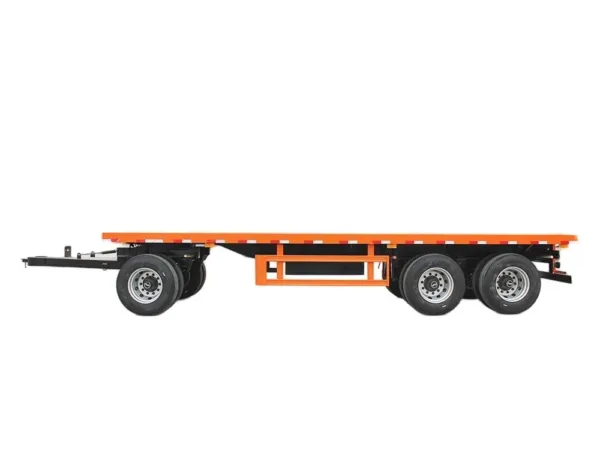
Skipping the axle count check. The axle count affects stability and how the trailer tracks behind the tractor. A buyer who assumes a single axle and receives a different layout has a trailer that behaves differently on slopes. Confirm the axle count on the quotation and ask for a side-view drawing. Do that before paying the deposit, not after.
Not confirming the dimensions. The dimensions are customised, so no standard size applies unless you state it. Buyers order from a photo and then find the bed is not the length they needed. Write the length, width and side height you want in the enquiry. Ask the supplier to repeat them back on the proforma invoice.
Leaving colour and payment terms loose. Colour is made to the customer’s need, and payment runs on a deposit with the balance before shipment. Buyers who confirm neither end up with a colour they did not expect or a shipment held at the port. State the colour code and accept the payment split in writing. Confirm both on the sales contract.
Buyer Questions
Can the trailer be supplied to my own dimensions?
Yes. The dimension is customised, so the bed length, width and side height are set by your order rather than a fixed catalogue size. Send the measurements you need, measured on your own tractor and intended load, and ask for a drawing before production. Confirm the finished dimensions on the proforma invoice. Without that written confirmation, a small farm tractor trailer can arrive at a size that does not suit your operation.
What payment terms apply, and when is the balance due?
The stated terms are a deposit with the balance paid before shipment. Plan the balance payment before the container is booked, because the trailer will not be released for loading until it clears. Ask the supplier for the invoice early enough to arrange the transfer. Confirm the exact split and the bank details on the sales contract. A small farm tractor trailer order moves faster when both payments are scheduled from the start.
Does the trailer ship assembled, and what does the buyer handle?
It ships partly broken down to save container space, with wheels, drawbar and tipping linkage packed separately. The buyer or importer handles assembly at destination. Ask for an assembly sheet and a packing list with the shipment, and check both against the delivered parts. Confirm at quotation who covers any lifting equipment at the destination port. A small farm tractor trailer that arrives labelled is quicker to assemble.
To quote your small farm tractor trailer, send the bed length and width you need, the axle count you want, and the quantity per order. Add your tractor hitch height and pin diameter, plus the colour you prefer. With those details, the supplier can confirm the specification, packing plan and container loading before you pay a deposit.
We use cookies to enhance your browsing experience, serve personalized content, and analyze our traffic. By clicking "Accept All", you consent to our use of cookies. Privacy Policy
Cookie Preferences
Required for the website to function properly. Cannot be disabled.
Help us understand how visitors interact with the website (Google Analytics).
Used to deliver personalized ads and measure ad campaign effectiveness.


















Write a Review