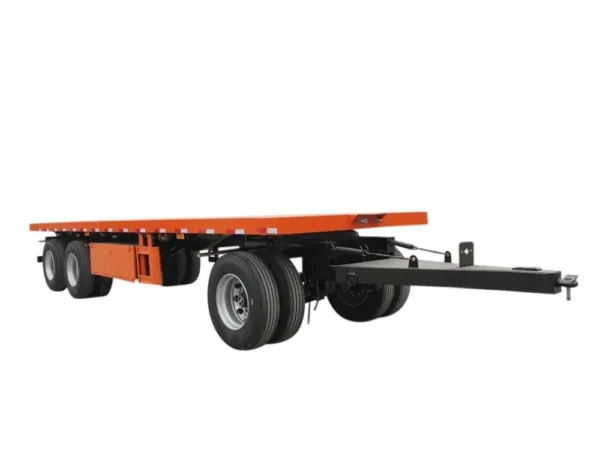
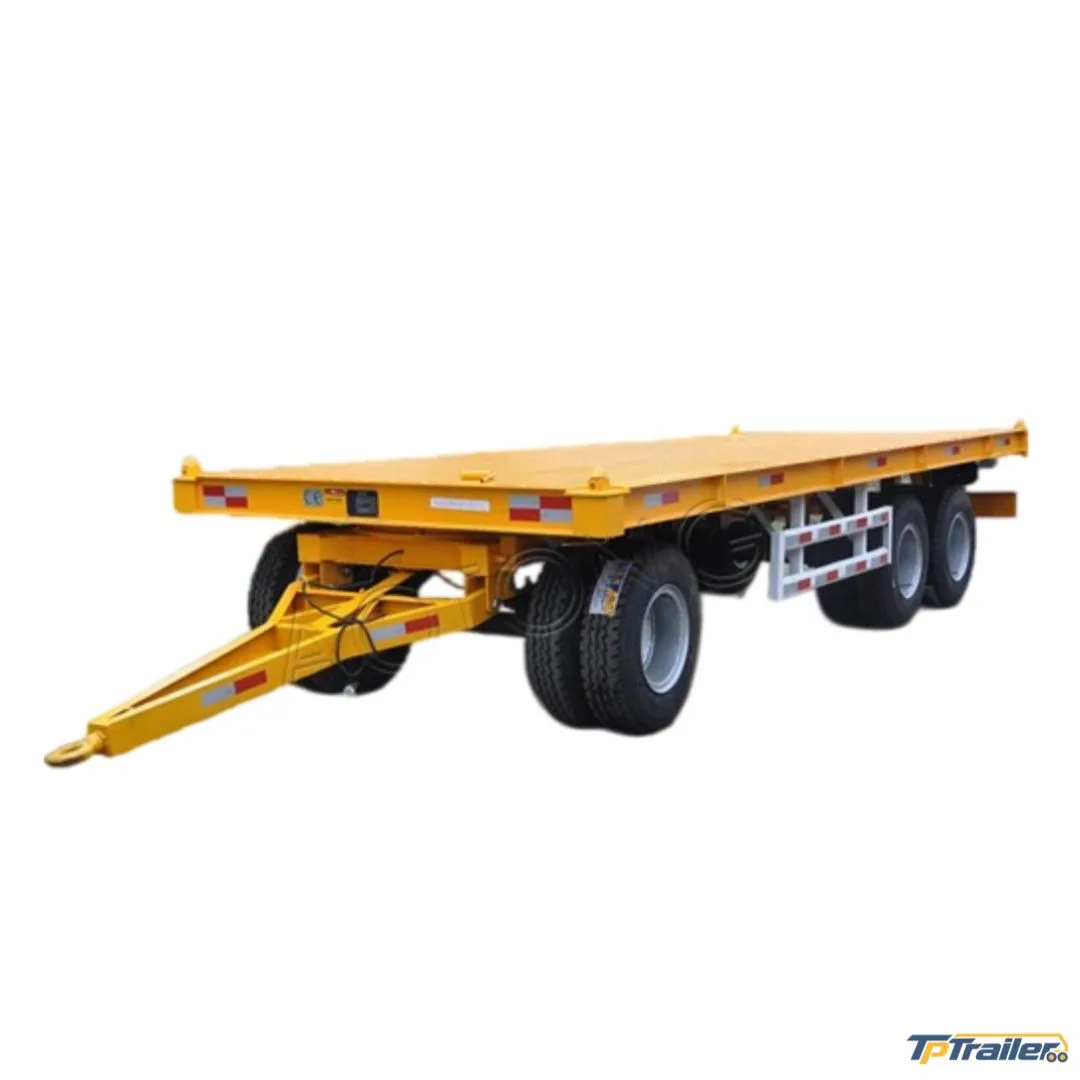
The 3 axle flatbed semi trailer is a heavy duty steel platform built to move containers and general cargo behind a drawbar coupling, with a rated load capacity above 30000 KG and below 100000 KG. It suits fleet operators, freight contractors and equipment dealers who need a rugged, simple-to-maintain platform rather than a specialised body. The strongest reason to choose it is the combination of a 13-ton axle brand, Yahua 28T landing gear and mechanical suspension: proven running gear that keeps a loaded platform stable on mixed road conditions and stays serviceable in the field. This is a working trailer, not a showpiece.
Table of Contents
Why It Works On Site
Load capacity band from 30000 KG upward. The platform is rated for heavy payloads, so one 3 axle flatbed semi trailer can carry a loaded container or dense flat cargo without splitting the job across two units. That reduces trips per shift and keeps the fleet moving on high-volume routes where every extra run costs fuel and driver hours.
13-ton axle brand on three axles. Three braked axles spread the load across the running gear, which keeps tyre and bearing stress lower on long hauls. For the buyer, that means predictable wear patterns and a platform that handles uneven loading better than a short-wheelbase unit, especially when cargo sits toward one end.
Mechanical suspension. A mechanical setup is straightforward to inspect and repair, with fewer components to fail than more complex systems. On site, that shortens downtime after rough-road damage and lets a maintenance team work with basic tools, which matters for fleets operating away from main depots.
Yahua brand 28T landing gear. Rated landing gear supports the trailer when uncoupled and loaded, so loading and unloading can happen with the tractor detached. That frees the prime mover for other work and lets yard crews spot the 3 axle flatbed semi trailer where the crane or forklift needs it.
Container transport function. The flatbed is set up for container hauling, so the same platform serves boxed freight and open flat loads. Operators avoid buying a dedicated skeleton trailer and gain a unit that stays productive between container jobs, which improves utilisation across a mixed freight calendar.
90 km/h maximum speed and multi-size tyre options. The speed rating matches normal highway running, while the tyre fitment choices let a buyer match the 3 axle flatbed semi trailer to local road surfaces and spare-part availability. That keeps replacement tyres easy to source and the fleet consistent.
Where It Is Used
Fleet operators use the 3 axle flatbed semi trailer for container hauling between ports, rail terminals, warehouses and distribution yards. A loaded container is locked down on the platform and moved as one unit, which suits scheduled shuttle work where the same route repeats daily. Because the deck is flat and open, cranes and reach stackers can lift boxes on and off without a dedicated dock.
The same trailer then carries steel sections, timber, pallets or bagged goods on the return leg, so the unit is not idle waiting for the next container. Operators running mixed freight calendars find this flexibility valuable, since one 3 axle flatbed semi trailer covers several cargo types instead of one narrow job. It also works well where loading is done by forklift from the side.
Construction and equipment supply chains rely on this platform for moving long and bulky items that will not fit a box body. Scaffolding bundles, pipes, formwork, prefabricated frames and machinery parts all sit on the open deck and are secured with straps or chains. The heavy load band means dense cargo such as stone, coil or rebar can be handled without overloading the running gear.
On regional routes and depot-to-site runs, the 3 axle flatbed semi trailer gives crews a stable platform that is easy to load from three sides. Maintenance teams also appreciate the mechanical suspension when the trailer works on unpaved access roads, because there is less to go wrong and repairs are simple. A second 3 axle flatbed semi trailer in the fleet covers peak periods without changing operating procedures.
Choosing The Right Spec
Match the load band to your heaviest regular cargo. The stated capacity range runs from 30000 KG upward toward 100000 KG, so buyers should size the 3 axle flatbed semi trailer against the densest load they move weekly, not the average. A fleet hauling containers part-loaded can work at the lower end; dense flat cargo needs headroom.
Pick tyre fitment by route and spares supply. The listed tyre options cover several common sizes, and the right choice depends on road surface, axle load and what local suppliers stock. Standardising on one size across a fleet keeps the 3 axle flatbed semi trailer serviceable and avoids mixed spares in the yard.
Weigh mechanical suspension against your maintenance setup. Mechanical suspension suits operators with in-house workshops and basic tooling, and it is easy to inspect. If your routes are mostly paved highway with steady loads, this setup keeps the 3 axle flatbed semi trailer simple and cost-predictable to run.
Confirm the drawbar and coupling arrangement. The drawbar setup defines how the trailer connects and turns, so buyers should confirm it matches their prime movers and yard layouts. Getting this right at order stage keeps the 3 axle flatbed semi trailer compatible with the tractors already in the fleet.
Customisation Before Delivery
The 3 axle flatbed semi trailer is built around a container transport function, so the deck layout and the fittings that hold the load are settled before the build starts. Buyers confirm the axle count and deck length at order confirmation, and the factory builds to that locked configuration rather than to a stock pattern. Nothing on the deck is changed after that point.
Axle specification is the first decision. The 3 axle flatbed semi trailer uses the 13-ton axle brand as its base arrangement, and the buyer states the axle count that matches the routes and the loads the trailer will carry. Because the axles set the load path through the frame, this choice is fixed at order confirmation and is not a field change.
Suspension type is chosen with the axle package. Mechanical suspension is the standard arrangement on this 3 axle flatbed semi trailer, and the buyer confirms it together with the axle count so the two are matched as one assembly. The combination is agreed at order confirmation, and the mounting points on the frame follow from it.
Tyre size is a separate selection. The 3 axle flatbed semi trailer can be specified with the tyre sizes listed for this model, and the buyer names the size that suits the surface and the load. Tyre choice affects the rolling radius and the clearance at the deck, so it is recorded at order confirmation along with the rest.
Finish and fittings close the list. Colour and the landing gear arrangement are confirmed for the 3 axle flatbed semi trailer at order confirmation, and the Yahua brand landing gear is specified as part of that package. Buyers who need a particular surface finish should raise it with the order rather than after the frame is painted.
Fitting And Installation
Fitting starts with the tractor. The buyer has to match the coupling height, the drawbar mounting points and the air and electrical connections on the towing unit to the trailer as built. On this 3 axle flatbed semi trailer, the drawbar and the landing gear positions are the reference points to check first, because they set the standing height and the hitching geometry. Confirm the tube size and the hose routing against the tractor before the trailer is moved under load. Where the input gives no fitment data, a fitment drawing is confirmed at quotation instead of being assumed from a catalogue. That drawing is the document the workshop should work from, not a verbal description over the phone.
A wrong size costs downtime that is easy to avoid. If the coupling height does not match, the 3 axle flatbed semi trailer sits nose-up or nose-down, and the axles carry the load unevenly from the first trip. If the hose routing is wrong, lines chafe against the frame and the trailer is off the road while they are replaced. If the tube size is wrong, the connections do not seal and the braking system is unreliable.
Each of these is a measurement taken before hitching, not a repair found afterwards. The 3 axle flatbed semi trailer is a heavy unit, so a mismatch is not corrected by adjusting the load. Check the mounting points, the tube size and the hose routing in that order, and confirm anything unclear against the fitment drawing at quotation.
Service Life And Maintenance
Tyres wear first on any 3 axle flatbed semi trailer, and the pattern of wear tells the operator what to check next. Uneven wear across an axle points to alignment or to load distribution, while wear on one side only points to the suspension. Inspect the tyres at every walk-around and record the tread depth so a trend is visible before a failure. The tyre size chosen at order confirmation sets the replacement part.
Suspension components are the next wear point on the 3 axle flatbed semi trailer. Mechanical suspension carries the load through bushes, shackles and the spring leaves, and these are what an operator should inspect for play, cracks and looseness. A visual check at each service and a check for movement under load will show a worn bush before it damages the spring. Replacing worn parts early protects the axle alignment.
Axle and wheel-end condition deserves its own check on the 3 axle flatbed semi trailer. The operator should look for oil or grease loss at the hubs, listen for bearing noise on the move and feel for heat at the wheel ends after a run. Heat at one hub against the others is a warning that should be investigated before the next trip. The 13-ton axle brand sets the parts to order.
Landing gear takes load every time the 3 axle flatbed semi trailer is uncoupled, and the Yahua brand landing gear should be inspected for bent legs, worn pins and free rotation. An operator should check that both legs extend evenly and that the feet sit flat on the ground. Keeping the screw threads clean and lightly lubricated extends the working life of the gear. A bent leg is replaced, not straightened.
Frame and deck condition close the routine on the 3 axle flatbed semi trailer. The operator should inspect the deck surface, the container fittings and the frame rails for cracks, corrosion and loose fastenings. A painted finish that is kept intact is what extends the interval before corrosion work is needed, so touch up chips when they appear. A clean, dry deck also keeps the container fittings working freely.
Packing And Container Loading
Sea freight protection for a 3 axle flatbed semi trailer starts with the steel structure itself. Deck surfaces and exposed frame edges are treated before shipment, and the drawbar and landing gear are braced so they cannot swing or bear load during transit. Loose items such as ramps, tools or spare wheel carriers are boxed and strapped to the deck rather than left to move. Buyers should ask the supplier to photograph the unit after treatment and again after loading. Those two photo sets show whether the protection survived handling and whether the cargo sits as planned.
Space saving is real but limited for this class of equipment. A 3 axle flatbed semi trailer is a long rigid unit, so it cannot be nested like small implements. Loading normally relies on the trailer occupying its own footprint, with the deck kept clear so nothing is stacked on the running gear. Where a buyer orders several units, the supplier can confirm whether deck-to-deck stacking or partial disassembly is practical, and that answer belongs in writing before booking freight. On arrival, verify frame straightness, axle alignment marks, tire condition and that every strapped item listed on the packing note is present.
Common Mistakes Buyers Make
Ordering the wrong deck length. A deck that is short for the cargo forces overhang and rework. Measure the longest load you intend to carry, add the securing margin you need, and confirm the deck length against that figure before signing. The single check is a tape measure against your cargo list, not a catalogue photo.
Ignoring the payload rating against the load. Buyers compare the headline load capacity with the actual cargo weight but forget the trailer’s own mass. Confirm the load capacity figure together with the axle brand rating and the tire specification, and ask the supplier to state the combination in writing on the quotation.
Mismatching the coupling and drawbar. The drawbar arrangement must suit the towing vehicle and local road rules. Check the coupling type, drawbar length and hitch height against your tractor unit before ordering a 3 axle flatbed semi trailer, and send the supplier a photo of your existing hitch.
Overlooking the tire and rim choice. Tire sizes listed for this model are not interchangeable without matching rims and axle spacing. Confirm the tire specification you want, then ask which rim and axle configuration supports it. The check is a written confirmation of tire, rim and axle as one set.
Skipping the suspension and speed review. Mechanical suspension and the rated maximum speed interact with road conditions and load. State your typical route and load profile, then confirm that the suspension type and speed rating suit it. A 3 axle flatbed semi trailer ordered for the wrong duty cycle is the most expensive mistake to correct.
Buyer Questions
Can the trailer be shipped in a standard container?
Usually not as a complete unit, because the assembled length exceeds container dimensions. Buyers should ask the supplier for the shipping configuration in writing, including whether partial disassembly is offered and what that does to the frame warranty. Confirm the port of loading and the freight forwarder’s dimensional limits before ordering a 3 axle flatbed semi trailer. If the unit ships break bulk or roll-on roll-off, ask for the loading photos and the securing plan, and check that the drawbar and landing gear are braced for the voyage.
What should I confirm about the axles and suspension before ordering?
Confirm the axle brand rating and the suspension type as a matched pair, because a 3 axle flatbed semi trailer is only as strong as the combination. Ask the supplier to state the axle brand, the suspension arrangement and the tire specification on the quotation, not just in a brochure. Then compare that set against your heaviest planned load and your route surface. If any element is unclear, request a written clarification rather than assuming the default configuration suits your operation.
How do I verify the load capacity claim?
Ask for the load capacity to be written on the quotation together with the axle brand rating and tire specification. Then weigh your heaviest intended cargo, including the container or implement, and compare that figure with the stated capacity. For a 3 axle flatbed semi trailer, the margin between cargo weight and rated capacity matters more than the headline number. Confirm any derating for rough ground or sustained high speed at quotation, and record the agreed figure in the purchase contract.
Send us the deck length you need, your preferred axle count and the quantity you plan to order. With those three details we can match the 3 axle flatbed semi trailer configuration to your cargo and confirm the quotation, packing plan and loading arrangement in writing before you commit.
We use cookies to enhance your browsing experience, serve personalized content, and analyze our traffic. By clicking "Accept All", you consent to our use of cookies. Privacy Policy
Cookie Preferences
Required for the website to function properly. Cannot be disabled.
Help us understand how visitors interact with the website (Google Analytics).
Used to deliver personalized ads and measure ad campaign effectiveness.



















Write a Review