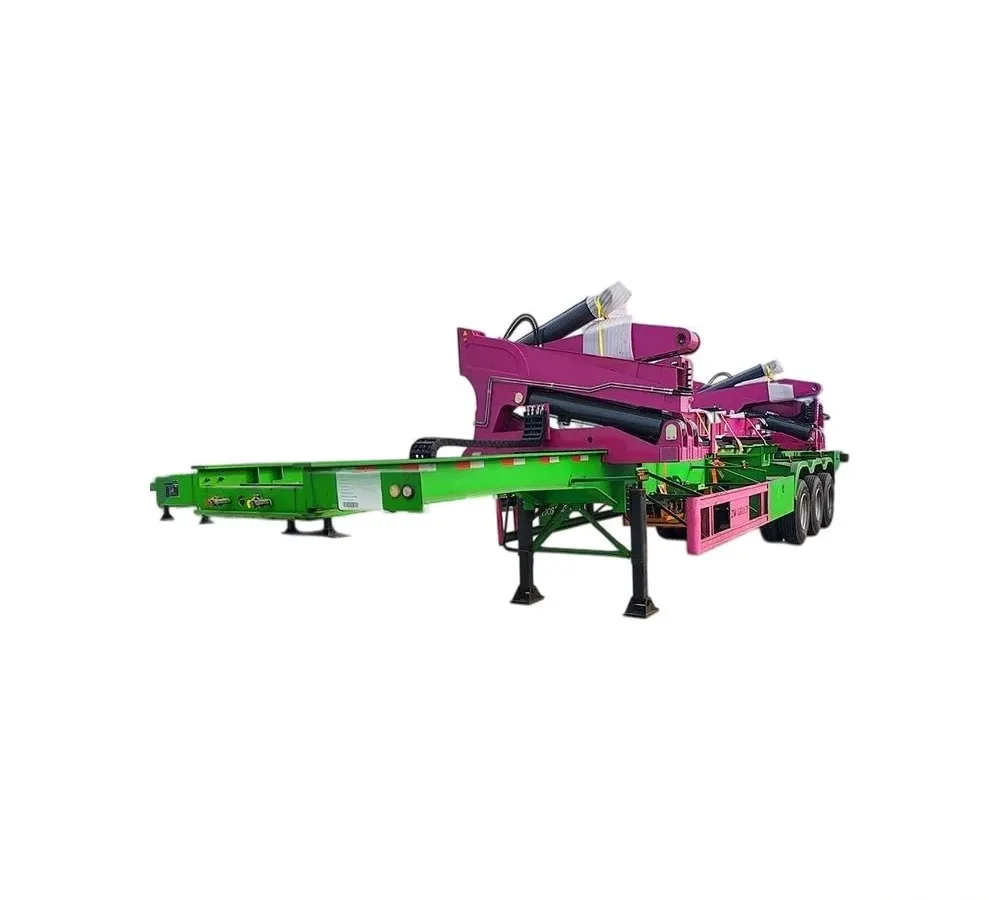
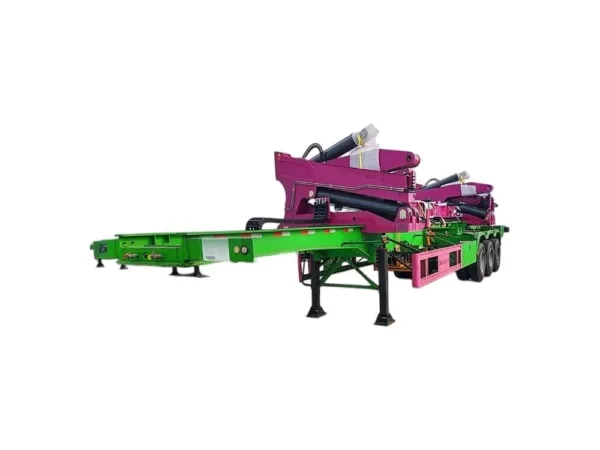
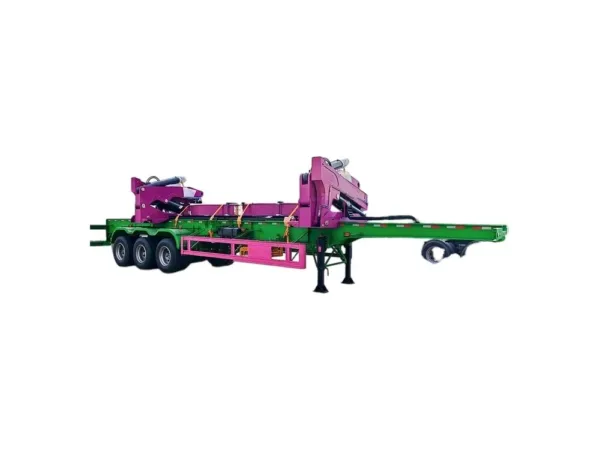
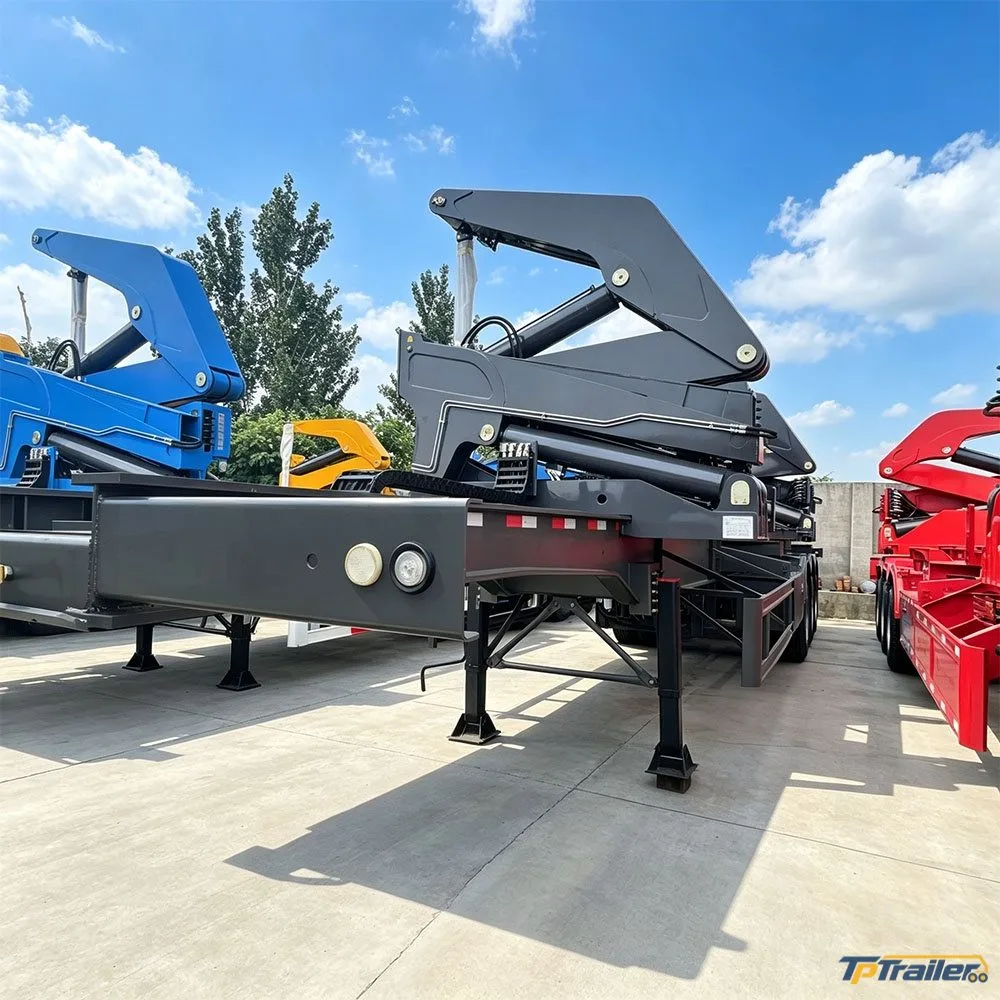
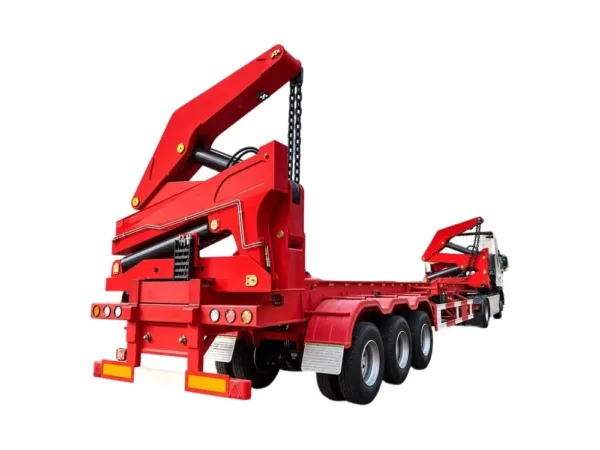
This container side loader semi trailer is a three-axle platform built to lift and set down shipping containers from the side, without a crane or a top-lift reach stacker. It is aimed at fleet operators, depot managers and hauliers who move boxed freight and need self-loading capability in yards where overhead lifting is unavailable or too costly to book. The strongest reason to choose it is the combination of high tensile steel construction and a rated load capacity of 30000 KG, which keeps the deck stiff under a loaded container while the side-lift assembly does the handling work. That pairing turns a standard flat platform into a machine that loads, carries and unloads in one pass.
Table of Contents
Why It Works On Site
Side-lift geometry removes crane dependency. The lifting assembly travels along the trailer frame and picks the container from the ground at the side, so a container side loader semi trailer can work a yard with no gantry, no reach stacker and no hired crane on site. That means one asset handles both the lift and the road leg, cutting the number of machines and operators tied to a single box movement.
High tensile steel frame carries the load and the lift forces. Lifting from the side puts bending and torsion into the chassis that a plain flatbed never sees. High tensile steel sections keep the frame stiff under those loads, so the deck stays flat and the container corners stay seated while the trailer is in motion. The operator gets predictable handling with a loaded box rather than a flexing platform.
Three-axle running gear spreads the weight. A loaded container plus the trailer’s own lifting equipment is a heavy combination. Distributing that mass across three axles keeps the load stable on the road and gives the driver a steadier platform at highway speed. It also gives the container side loader semi trailer a footprint that suits long trunk runs as well as short depot shuttles.
30000 KG load capacity sets the working envelope. The rated load capacity of 30000 KG tells the buyer which container and cargo combinations the trailer is built to handle. That figure is the planning number for dispatch: it defines what the container side loader semi trailer can be scheduled to carry, so loading decisions are made against a known limit rather than an estimate.
Self-loading cuts turnaround time at each stop. Because the trailer loads itself, a driver can arrive, lift the box off the ground, secure it and leave without waiting for separate lifting equipment. On multi-stop work this removes the queue at the yard entrance, and the container side loader semi trailer spends more of its day moving freight instead of standing still between lifts.
One trailer covers handling and haulage. Buying a container side loader semi trailer means the lifting capability and the road transport capability arrive as a single unit. There is no separate handling machine to maintain, fuel or insure, and no coordination between two operators for one box. For a fleet adding side-loading capability, that consolidation is the practical argument.
Where It Is Used
The most common job for a container side loader semi trailer is depot and warehouse work where boxes arrive by road and need to be set down without overhead lifting. A driver pulls alongside a stacked or ground-set container, lifts it from the side, carries it to the loading bay and places it where the warehouse team needs it.
This suits container yards with limited space between rows, sites where a crane cannot be positioned, and warehouses that receive boxed freight on a schedule but have no permanent lifting equipment of their own. In these settings the trailer does the handling and the haul in one movement, which is why depot managers treat it as a working asset rather than a transport-only unit.
The second setting is road haulage between depots, ports and inland terminals, where the same trailer loads at one end and unloads at the other. A container side loader semi trailer on this duty carries standard boxed cargo on trunk routes and regional runs, then handles the lift at each end without waiting for site equipment.
Fleet operators recognise the pattern: a box needs to move from a yard with no crane to a site with no crane, and the trailer closes that gap on its own. It also fits shuttle work between a storage yard and a production site, where containers are dropped and picked on a repeating cycle and the trailer is the only lifting machine on the ground.
Choosing The Right Spec
Match the load capacity to the boxes you actually move. The rated load capacity of 30000 KG is the number to check against the container and cargo weights in your schedule. A container side loader semi trailer working loaded boxes near that figure needs the trailer specified for that duty, while lighter cargo leaves margin. Start from the heaviest combination you expect to haul.
Decide whether three axles suit your routes. The three-axle layout spreads the loaded weight and gives stability on longer road legs. If most of your work is short depot shuttles, the same container side loader semi trailer still fits, but the axle count is chosen around the road distance and the weight you plan to carry rather than the yard work alone.
Confirm the side-lift direction against your yard layout. Side loading needs clear ground on the lifting side of the trailer. Before ordering a container side loader semi trailer, walk the yard and check that the lift path is open at each stop. Where space is tight on one side, the loading direction and approach become part of the specification decision.
Weigh the price tiers against fleet size. The published tiers move with order quantity, so a single unit and a multi-unit order sit at different points. A fleet adding several container side loader semi trailer units should plan the order as one block to reach the better tier, while a first unit can be bought alone to prove the duty cycle before scaling.
Customisation Before Delivery
Axle configuration. The container side loader semi trailer is built around the axle set you select at order confirmation. Buyers running mixed fleets can align the unit with the rest of their workshop stock, so bearings, brake chambers and seals stay common across the fleet. State the axle count you need when the order is placed, and the build sheet is frozen from that point.
Deck length. Deck length is chosen against the container sizes you actually handle. A shorter deck suits yard-to-yard shuttle work, while a longer deck gives more room for positioning during side loading. Because the deck is a structural part of the container side loader semi trailer, the length is settled at order confirmation rather than changed later on the shop floor.
Suspension type. Mechanical and air suspension options are confirmed against your route profile and load mix. Air suspension suits operators who want load-height control at the warehouse dock. Mechanical suspension suits simpler maintenance routines. The choice is recorded on the order for the container side loader semi trailer, and the mounting brackets are matched to it before fabrication begins.
Tyres and wheels. Tyre size and tread pattern are selected for the ground you run on, from sealed yard concrete to mixed gravel access roads. Wheel stud pattern and rim offset are agreed at the same time. For a container side loader semi trailer working beside warehouse doors, the tyre choice is agreed at order confirmation so the spare set matches.
Colour and finish. Body colour and finish are agreed from the available options at order confirmation. Operators often match the unit to an existing trailer pool or to a site colour code. Finish choice affects how the steel is protected in service, so it is worth deciding early rather than repainting later. The container side loader semi trailer is painted to the confirmed specification.
Fitting And Installation
On arrival, the buyer has to match the container side loader semi trailer to the tractor unit that will pull it. Check the fifth wheel coupling height, the kingpin position and the clearance around the landing legs before the first hook-up. Confirm that the electrical connector, air line couplings and hose routing line up with the tractor, because a mismatch here keeps the trailer parked. The mounting points for any site-fitted equipment should be checked against the frame before drilling. Where the input gives no fitment data, a fitment drawing is confirmed at quotation, so the interface dimensions are agreed in writing before the build starts.
A wrong size at the interface is expensive in downtime, not in parts. If the coupling height is off, the deck sits at the wrong angle for side loading and the container transfer becomes unsafe to attempt. If the hose routing is wrong, lines chafe against the frame and the trailer is pulled from service for repair. If the axle track or tyre package does not match the yard layout, every docking manoeuvre takes longer. The container side loader semi trailer is a working asset, so the fitment check is worth a full shift on day one rather than a quick visual pass.
Service Life And Maintenance
Axle and bearing wear. Wheel-end components are usually the first to show wear on a container side loader semi trailer. Operators should inspect bearings, seals and brake adjustment at each scheduled service and watch for heat or noise after long runs. Keeping the axle set matched to the load profile extends the interval between rebuilds. Record every inspection so trends are visible before a failure stops the yard.
Suspension and bushings. Suspension bushes and shackle pins take the repeated shock of loaded container transfers. Inspect them for play, cracking and uneven tyre scrub. The suspension type chosen at order confirmation sets the inspection routine, so follow the schedule for that system. A container side loader semi trailer that works on rough ground needs these checks more often than one that stays on sealed concrete.
Steel frame and coating. The high tensile steel frame should be washed down and inspected for coating damage, especially around welds and mounting points. Touch up any chip before rust starts. The colour and finish chosen at order confirmation affects how well the steel resists site conditions, so a coating check belongs in the routine. A container side loader semi trailer kept clean and touched up holds its structure longer.
Hydraulic and side-loading hardware. Hoses, fittings and moving parts on the side-loading assembly should be checked for leaks, chafe and loose fasteners. Route hoses away from sharp edges and confirm they are clipped as agreed at quotation. Operators should cycle the mechanism unladen before each shift. On a container side loader semi trailer, small leaks caught early are far cheaper than a hose failure under load.
Tyres and load distribution. Tyre pressure and tread depth should be checked weekly, with attention to uneven wear that points to alignment or suspension issues. Load distribution matters on this trailer, so confirm the load sits within the stated load capacity. The tyre package selected at order confirmation sets the pressure routine. A container side loader semi trailer with even tyre wear is usually a trailer with sound alignment.
Packing And Container Loading
Each container side loader semi trailer is prepared for sea freight as a disassembled or partly assembled unit. Steel structure faces are cleaned and coated with protective film before shipment. Small fittings, pins and fasteners are boxed and strapped to the main frame so they cannot move during transit. Hydraulic lines and exposed cylinders are capped and wrapped. Buyers should confirm the exact packing arrangement at quotation, because the container side loader semi trailer ships as a long frame assembly that needs careful lashing points and clear loading diagrams from the supplier.
Space saving depends on the build. A container side loader semi trailer is not a nesting part in the way a bracket or hub is, so stacking is limited by the frame length and the crane structure. Suppliers may remove or fold selected components to reduce the loaded volume, and the buyer should ask for the loaded dimensions before booking freight. Verify on arrival that the frame is straight, the coating is unbroken, and every boxed fitting matches the packing list. Photograph the container interior before unloading the container side loader semi trailer, and report any shift or damage to the carrier in writing.
Common Mistakes Buyers Make
Assuming a standard container will fit the frame. The loaded length and height of a container side loader semi trailer often exceed what a buyer pictures. Check the loaded dimensions against the internal dimensions of the container you plan to book, and ask the supplier to confirm the shipping configuration before you pay a freight deposit.
Ignoring the load capacity rating. Buyers compare frames on price and forget the rated load. State the heaviest container and cargo weight you will handle, and confirm the rating covers it. The single check is a written match between your duty cycle and the load capacity stated on the quotation.
Ordering the wrong axle configuration. Axle count and spacing affect road rules, turning behaviour and dock access. Confirm the axle count you need for your routes and the load you carry. Ask for the axle layout drawing and check it against local weight-per-axle limits before signing the order.
Skipping the coupling and kingpin check. A container side loader semi trailer must match your tractor unit. Measure the fifth wheel height, confirm the kingpin size, and check the landing gear position. The single check is a dimensioned drawing of the coupling area compared with your tractor before production starts.
Forgetting the handling envelope. Side loading needs clear space beside the container and a firm, level surface. Buyers order the trailer and then find the yard too tight. Measure the working width and ground bearing at your site, and confirm the required clearance with the supplier before the build is released.
Buyer Questions
Can the container side loader semi trailer be shipped in one standard container?
That depends on the shipping configuration, and the answer should come from the supplier in writing. Ask for the loaded length, width and height of the unit as packed, then compare those figures with the internal dimensions of the container you intend to book. If the frame cannot be broken down far enough, the container side loader semi trailer may need a different shipping method or a different container type. Confirm this before you commit to freight, because re-booking after packing is costly.
What should I measure on my tractor before ordering?
Measure the fifth wheel height from the ground, confirm the kingpin size, and note the tractor wheelbase. Also record the clearance around your yard and the surface condition where the container side loader semi trailer will work. Send those measurements with your enquiry so the supplier can check the coupling area and the handling envelope. If any figure is outside the standard build, ask for it to be confirmed at quotation rather than assumed.
How is the load capacity rating proven?
The rating is a design figure stated on the quotation and the specification sheet, not a test result supplied with every unit. Tell the supplier the heaviest container and cargo weight you plan to handle, and ask for written confirmation that the container side loader semi trailer is rated for that duty. If you need documented load testing, request it as a separate item and have the method confirmed at quotation before production.
Send your required trailer length, axle count and order quantity for a quotation on the container side loader semi trailer. Add your tractor coupling dimensions and the heaviest container weight you handle, so the specification can be checked against your duty cycle before the build is confirmed.
We use cookies to enhance your browsing experience, serve personalized content, and analyze our traffic. By clicking "Accept All", you consent to our use of cookies. Privacy Policy
Cookie Preferences
Required for the website to function properly. Cannot be disabled.
Help us understand how visitors interact with the website (Google Analytics).
Used to deliver personalized ads and measure ad campaign effectiveness.


















Write a Review