


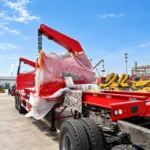

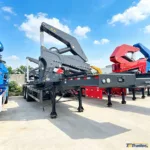

The 40ft container side loader trailer with 3 axles lifts up to 30000 KG, handling container transport at cargo terminals with stable side-loading.

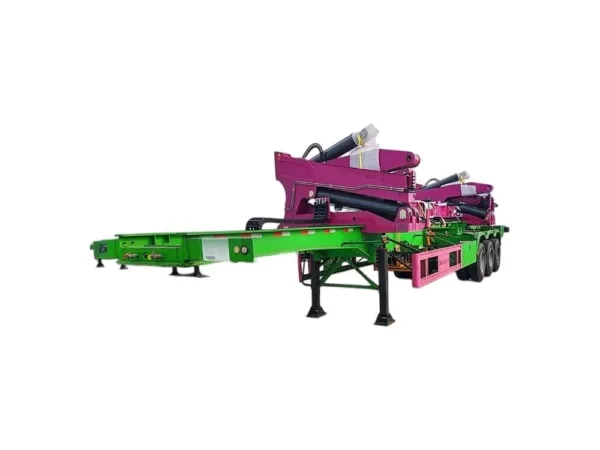

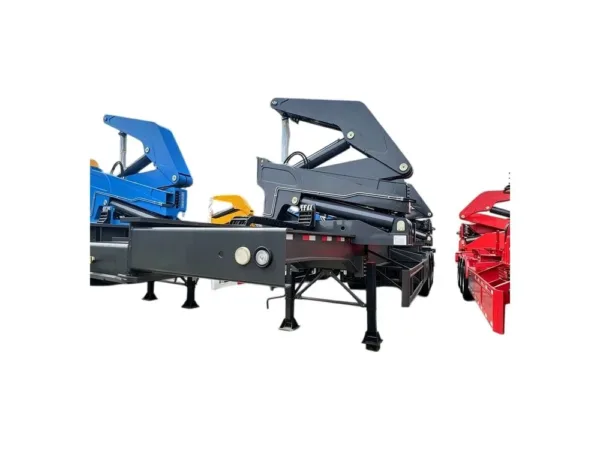
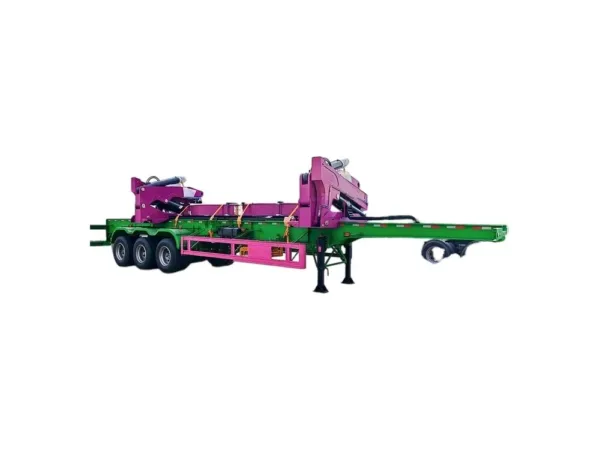

The 40ft container side loader trailer is a three-axle unit built to lift and set down 40ft containers from the side of the chassis, without a crane or a top-lift reach stacker on the ground. It is made for container yards, cargo terminals and haulage fleets that move boxes between stacks, gates and rail sidings. The strongest reason to choose it is the 30000 KG load capacity paired with a side-lift assembly: one operator can load and unload a full container at the roadside or on a packed terminal apron, so the trailer earns its keep on jobs where a crane cannot reach.
Container terminals and cargo yards are the first home for this trailer. A 40ft container side loader trailer can lift a box from a ground stack beside the lane, carry it to the gate or to a rail siding, and set it down without calling a yard crane. That suits depots that handle steady import and export flows but do not run a full crane spread all day. It also suits terminals where the crane is busy on vessel work and the road fleet still needs to turn boxes. The trailer keeps the collection and delivery side moving while the quay operation runs on its own schedule.

Haulage fleets use the 40ft container side loader trailer on routes where the box has to come off the chassis away from a loading dock. That covers roadside drop-offs, customer premises without a ramp or crane, and short repositioning legs between yards. Empty container repositioning is another common job, because the trailer can lift and stack boxes in a depot without extra equipment. For a fleet operator running mixed work, the 40ft container side loader trailer covers terminal shuttles, depot shuffles and customer deliveries with one unit, which keeps utilisation up on days when crane access is the bottleneck.
Rail sidings and inland depots are a third setting. Where a box arrives by train and has to move to a road chassis, the side-lift assembly lifts it clear of the ground stack and places it on the deck without a fixed crane on the pad. The unit also suits operators who take on overflow work at short notice: because the lift travels with the trailer, a fleet can accept a job at a site that has no handling equipment at all, and the 40ft container side loader trailer does the lifting on arrival.
On arrival, the buyer has to match the trailer to the tractor unit that will pull it. That means checking the coupling height, the kingpin engagement, the electrical socket type and the air line connections against the drawing agreed at quotation. The 40ft container side loader trailer is delivered as a complete unit, but the interface with the tractor is the buyer’s side of the job.


Confirm the fifth wheel height and the coupling position before the trailer is moved, because a mismatch here stops the unit from being coupled safely. Hydraulic and pneumatic lines run to fixed points on the frame; route them clear of moving parts and check every connection against the fitment drawing. Where the input gives no fitment data, a fitment drawing is confirmed at quotation rather than assumed.
A wrong size at the coupling or a mis-routed hose costs the buyer downtime, not just a return. A trailer that cannot couple holds up the first container movement and ties up yard space while the issue is resolved. Hose routing that fouls a moving part can damage a line during the first lift, which takes the 40ft container side loader trailer out of service until it is repaired.
The practical defence is to check the fitment drawing against the tractor and the site before delivery, and to walk the hydraulic and air runs once the unit is on the ground. Treat the first coupling as an inspection, not a formality, and record what was checked so later faults are easier to trace.
Commissioning is the second step. Before the first loaded lift, cycle the assembly through its full travel empty and watch for binding, uneven arm movement or hose stretch at the pivot points. An empty cycle is the cheapest test a buyer can run, and it tells the operator whether the lift circuit is plumbed and bled correctly. Only after that should the 40ft container side loader trailer take a loaded box, and the first loaded lift should be done with the yard clear so any adjustment can be made without pressure.
A written schedule is what makes the list above work in practice. Set a daily walk-around for hoses, tyres and visible damage, a weekly check of pin play and fastener torque, and a deeper inspection of the lift circuit at longer intervals set by your own workshop. The 40ft container side loader trailer is a working tool, and the operator who logs each check builds a record that supports warranty conversations and resale value alike.
A 40ft container side loader trailer ships as a long structural unit, so protection starts with the steel frame. Exposed hydraulic rams, control valves and hose runs are wrapped or capped, and the lifting assemblies are secured against movement in transit. Buyers should ask the supplier to confirm which components are removed or braced for the voyage. The aim is simple: no unpainted surface rubbing against a container wall, and no load path left to carry the trailer’s weight on a weak point.
Nesting is limited because the frame and lifting gear form a fixed envelope. A 40ft container side loader trailer is normally loaded as a single unit or in a small group, not stacked like flat racks. Ask for a loading plan showing where each unit sits and how it is lashed. On arrival, check the frame for distortion, verify the hydraulic circuit holds pressure, and confirm every detached part matches the packing list before signing the delivery note.
Lashing points matter as much as the plan itself. Confirm where the slings attach, that the points are rated for the unit’s shipping weight, and that the receiving terminal has equipment able to lift the envelope you are sending. A 40ft container side loader trailer that arrives with a bent ram or a chafed hose run is a warranty argument waiting to happen, and a photographed condition report taken at handover settles most of those questions before they start.
Two more errors sit outside the list and cost buyers just as much. The first is buying on price alone without checking that the quoted configuration matches the drawing you approved; a cheaper unit that arrives with a different axle arrangement is not cheaper once it is rejected at the gate. The second is skipping the site survey: measure the clear space beside the lane, the gate width and the turning circle before the 40ft container side loader trailer is ordered, because lift geometry that does not fit the yard cannot be fixed after delivery.
Length and frame height decide this, so measure the overall length and the highest fixed point before you order. Send those figures to the supplier and ask for a loading drawing. A 40ft container side loader trailer may need flat rack or break bulk handling depending on its envelope. Confirm the shipping method and lashing plan in writing, and check the receiving terminal can lift and move the unit on arrival.
Ask which functions are hydraulic, what flow and pressure the circuit needs, and whether a power source is included. If you plan to drive it from a tractor unit, confirm the connection type matches your fleet. For a 40ft container side loader trailer, the lifting circuit is the core function, so request the hydraulic schematic and check hose routing and cylinder placement against your operating site.
List every container length and type you handle, then ask the supplier to confirm the lock positions and lifting points cover them. Measure your yard clearances and turning space too. A 40ft container side loader trailer works within a fixed envelope, so a mismatch shows up on the first lift. Request the dimensional drawing and compare it with your site before you place the order.
Ready to quote a 40ft container side loader trailer? Send your required overall length, the axle count you need, and your order quantity. With those three details the supplier can confirm the configuration, the packing plan and the shipping arrangement. Include your container sizes and route limits so the specification matches your operation from the first lift.
Explore more 40ft container side loader trailer in this range.
| Load Capacity | >30000 KG | Type | Semi-Trailer |
|---|---|---|---|
| Max Payload | >30000 kg | Place of Origin | China |
| Use | Truck Trailer | Material | Steel |
| Size | 14100mm × 2500mm × 4100mm | ||


No reviews yet — click the Review button on the right to share your experience with this product.








Fill in the form below and our team will respond within 24 hours.
Write a Review