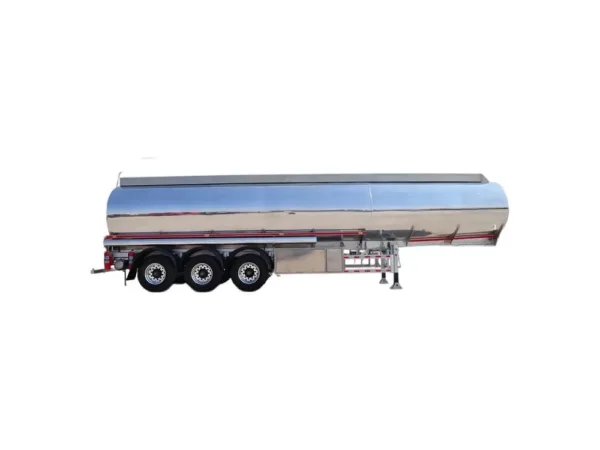
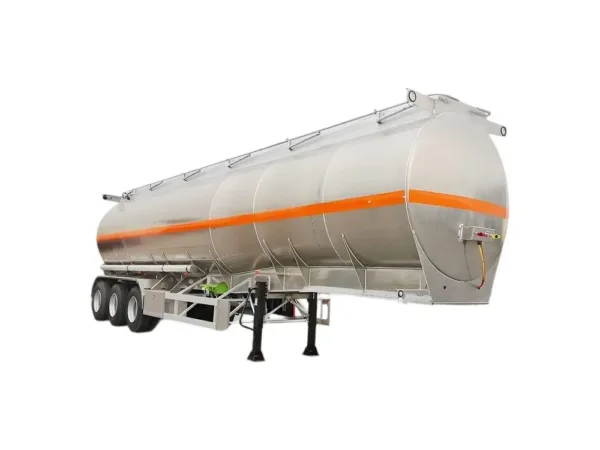
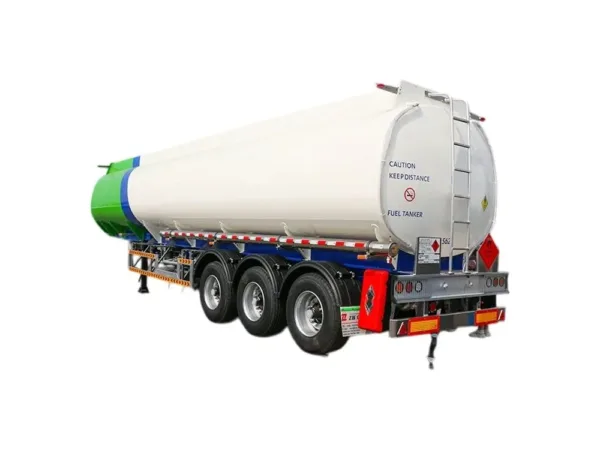
Lightweight aluminum fuel tanker trailer transport starts with the tank shell, not the badge on the side. This unit is a three-axle semi trailer built to move diesel, gasoline and other petroleum products in bulk, with a 45000 load capacity carried in an aluminum alloy barrel. It suits fleet operators, fuel distributors and haulage contractors who move product daily and are paid per delivered litre, not per trip. The single strongest reason to choose it is the payload-to-weight balance: aluminum lets the barrel hold a large volume without dragging a heavy steel shell behind the tractor, so more of every legal load is saleable cargo. That is the case for lightweight aluminum fuel tanker trailer transport in one line.
Table of Contents
Why It Works On Site
The 45000 load capacity sets the working size of every run. A barrel rated to that figure lets a hauler plan around full loads instead of partial ones, which is what lightweight aluminum fuel tanker trailer transport is bought for. Dispatch can match a single trailer to a terminal allocation and keep the tractor turning, rather than splitting a drop across two units and paying twice for the same road.
The aluminum alloy barrel cuts dead weight. Every kilogram saved in the shell is a kilogram available for product, so the same tractor and the same route carry more saleable fuel. That margin compounds across a week of shifts. It is also why lightweight aluminum fuel tanker trailer transport suits operators running long trunk routes where fuel burn and toll class both follow gross weight.
Three axles spread the load across the road. Distributing the barrel mass over three axle sets keeps individual axle loads inside normal highway limits and steadies the trailer under braking and crosswind. For lightweight aluminum fuel tanker trailer transport on mixed highway and secondary roads, that stability is what lets drivers keep scheduled speeds instead of nursing a swaying barrel.
Diesel, gasoline and petroleum service share one barrel design. A single trailer type can be scheduled against different product queues at the terminal, so the fleet is not split into single-product assets. That flexibility is central to lightweight aluminum fuel tanker trailer transport planning: one asset class, several cargo assignments, fewer idle days between contracts.
Aluminum resists the corrosion petroleum work brings. Condensation and product residue attack mild steel from the inside, and a barrel that pits loses service life quietly. An alloy shell holds up better against that daily exposure, which keeps lightweight aluminum fuel tanker trailer transport viable over a long service window and protects resale value when the unit is eventually rotated out.
Semi trailer format fits standard tractor fleets. The unit couples to a conventional tractor unit, so a hauler can add capacity without buying a new prime mover or retraining drivers. That is the practical entry point for lightweight aluminum fuel tanker trailer transport: existing power units, existing workshops, existing drivers, one new asset earning from the first dispatch.
Where It Is Used
The clearest job is terminal-to-station fuel delivery. A distributor loads at a bulk depot and runs a fixed route of filling stations, dropping partial loads at each stop. The 45000 load capacity means fewer return trips to reload, and the three-axle layout keeps the barrel settled through repeated stop-start work in traffic.
Operators running lightweight aluminum fuel tanker trailer transport on this pattern value the short turnaround at each site more than outright speed, because the day is measured in drops completed. The same pattern covers depot-to-depot transfers, where a full barrel moves between storage terminals and the trailer spends its time on highway rather than in town. In both cases the trailer is a scheduled asset, dispatched against a product queue rather than a single customer.
A second pattern is long-haul petroleum movement between regions. Here the trailer runs loaded for hours at a time, and the payload-to-weight balance decides the economics of the trip. Lightweight aluminum fuel tanker trailer transport suits this work because the alloy barrel keeps gross weight down while the load stays high, so fuel burn and tyre wear stay reasonable over distance.
Cargo types are the everyday petroleum set: diesel for transport and industry, gasoline for retail forecourts, and related light products handled on the same schedule. Fleet managers on these routes plan around axle loading and driver hours rather than urban manoeuvring, and a three-axle semi trailer fits that planning model. The trailer also serves construction and mining fuel supply, where a site tank is refilled from a depot run.
Choosing The Right Spec
Match the 45000 load capacity to your heaviest regular drop. If most runs are full-barrel transfers between terminals, the rated capacity is the figure that matters and the trailer should be scheduled to use it. Where drops are partial and frequent, the same barrel still works, but plan dispatch around volume per stop rather than the maximum. Either way, lightweight aluminum fuel tanker trailer transport pays off when the barrel is filled, not when it runs half empty.
Three axles suit highway and regional routes. The axle count spreads load and steadies the barrel at speed, which is what long trunk runs need. If your work is mostly short urban delivery with tight forecourts, check turning geometry against your sites before committing. For lightweight aluminum fuel tanker trailer transport across mixed road classes, the three-axle semi trailer layout is the conventional and well-understood choice for a fleet.
Aluminum alloy barrel against steel depends on your product mix. Alloy saves weight and resists petroleum corrosion, which supports lightweight aluminum fuel tanker trailer transport economics over a long service life. Steel is heavier and needs more internal protection against the same products. Choose on how long you intend to hold the asset and how corrosive your cargo stream is, not on purchase price alone.
Volume planning follows the cargo, not the badge. Diesel, gasoline and light petroleum products behave differently in loading and discharge, so confirm the barrel suits the product you move most often. A fleet running one dominant product gains most from lightweight aluminum fuel tanker trailer transport on a fixed schedule. A fleet mixing products needs the flexibility to reassign the trailer between queues without rework.
Customisation Before Delivery
Axle configuration. The running gear is the first choice a buyer settles, because it decides how the load is shared across the road and how the rig behaves when a tank is part full. A three-axle layout suits steady line-haul work on paved routes. Every axle option is written into the order confirmation so the factory builds to one agreed sheet rather than a verbal note. Lightweight aluminum fuel tanker trailer transport planning starts with this decision.
Suspension type. Mechanical and air-ride systems behave differently under a loaded tank, and the choice affects ride harshness, tyre wear and how the barrel is isolated from road shock. Buyers moving petroleum products over long distances often weigh the two against route quality and maintenance capacity. The selection is locked at order confirmation, and the suspension is matched to the axle set you pick. Lightweight aluminum fuel tanker trailer transport depends on stable suspension.
Tyre specification. Tyre size, load rating and tread pattern are confirmed with the order, since the running gear and the tyre must agree on load capacity and rolling diameter. Operators facing mixed surfaces may prefer a different pattern from those staying on sealed highways. Because the tyre choice follows the axle and suspension decision, all three are reviewed together before the build sheet is signed.
Barrel and finish options. Compartment layout, baffle arrangement and external finish are agreed at order confirmation, so the delivered unit matches the product you carry and the climate it works in. Coating and surface treatment choices are recorded on the same sheet. Buyers planning lightweight aluminum fuel tanker trailer transport across hot, dusty regions often raise finish questions early, and those answers belong in the signed order.
Ancillary fittings. Hose carriers, cabinet positions, ladder placement and discharge routing are selected before production begins. These details look minor on paper but decide how quickly a driver can work at a depot or roadside stop. Each option is confirmed in writing, and the agreed configuration is what the factory builds and what the pre-delivery check is measured against.
Fitting And Installation
On arrival, the tractor and the trailer have to agree on the mechanical interface before any product is loaded. The kingpin, the landing gear position, the air and electrical coupling points and the mounting points for any auxiliary equipment must line up with the towing vehicle. Hose routing deserves the same attention: discharge lines, vapour recovery connections and valve access need a clear path that does not foul the tractor frame or the rear cabinet.
Where the input gives no fitment data, a fitment drawing is confirmed at quotation, so the buyer can check the tractor against the drawing before the unit ships. That drawing is the reference for torque values and connection points, and it should be reviewed by the workshop that will do the hook-up, not only by the purchasing office. Getting this right is the quiet foundation of lightweight aluminum fuel tanker trailer transport.
A mismatch discovered after delivery is expensive in a way that is easy to underestimate. A coupling that does not mate, a hose run that has to be re-routed or a mounting point that sits a few millimetres off can keep a tanker parked while the workshop fabricates adapters and waits for parts. For an operator moving diesel, gasoline or petroleum products on a schedule, every idle day is lost revenue and a missed delivery window.
The cost is not just the repair; it is the crew standing by, the load that has to be re-booked and the customer who has to be told. Confirming the fitment drawing at quotation, then comparing it against the actual tractor, removes most of that risk before the unit ever leaves the yard. Lightweight aluminum fuel tanker trailer transport rewards preparation at this stage.
Service Life And Maintenance
Barrel surface and welds. The aluminum shell is the first thing to watch, because road debris, stone chips and chemical splash all attack the outer skin. Operators should inspect welds, seams and the underside after long runs on rough routes. A protective finish chosen at order time extends the interval between cosmetic repairs and helps the barrel stay sound through years of lightweight aluminum fuel tanker trailer transport.
Valves, seals and gaskets. These are the parts that wear first in daily service, because they cycle every load and every discharge. Inspect for weeping, hardening and correct seating at each turnaround, and replace seals before they fail rather than after. Material choice at order confirmation determines how well the fittings tolerate the products you carry, so the specification should match the cargo.
Suspension and running gear. Bushings, shackles and air bags take the load shock that the barrel should never feel. Check them for play, cracking and uneven wear, and watch tyre wear patterns for signs of misalignment. A suspension type selected for your route profile keeps this wear predictable and supports steady lightweight aluminum fuel tanker trailer transport over the life of the unit.
Brake and air system. Brake chambers, lines and fittings should be inspected for leaks, chafing and corrosion at every service stop. Air system integrity matters most on a loaded tanker, where stopping distance is not negotiable. Keep the lines clear of the frame and cabinet edges, and treat any pressure loss as a fault to trace immediately rather than a nuisance to live with.
Mounting points and fasteners. Vibration loosens what inspection ignores. Check the mounting points, brackets and fasteners that tie the barrel and ancillaries to the chassis, and confirm torque against the fitment drawing confirmed at quotation. This is the cheapest maintenance on the unit and the one that most directly protects lightweight aluminum fuel tanker trailer transport from a costly structural failure.
Packing And Container Loading
The tanker ships as a complete unit or in agreed sections. Exposed aluminum surfaces get a protective wrap. Fittings, valves and hose trays are boxed or braced so they cannot strike the shell. Lightweight aluminum fuel tanker trailer transport rewards careful loading, because a bare shell marks easily and a dropped strap can dent a barrel. Buyers should ask the supplier how the shell, the frame and the running gear are each protected before the unit leaves the yard. The packing list should match the parts you ordered, item by item.
Nesting and stacking are not practical for a finished tanker. The shell is a fixed shape and the axles sit below it, so units load side by side on flat racks or roll-on decks. Lightweight aluminum fuel tanker trailer transport planning should start with overall length and width, because those dimensions decide how many units fit per shipment. Ask the supplier for the shipping dimensions in writing and confirm the vessel or flat-rack booking before production ends. On arrival, check the wrap, the shell surface, the fittings boxes and the frame for movement, and photograph any damage before unloading.
Common Mistakes Buyers Make
Assuming the tank volume fits every route. Buyers order by capacity alone and later find the overall length does not suit local road rules. The single check that avoids this is to measure the routes the trailer will run and compare the shipping dimensions against them before you sign the order.
Ignoring the axle count against the load. A buyer fixes the capacity but not the axle configuration, and the finished unit does not match the permit or the tractor. The check is to confirm the axle count you need and have it written into the order description, not left to the drawing.
Overlooking the discharge fittings. The valve layout and outlet positions are assumed rather than agreed, so the trailer cannot serve the depot. The check is to list the fittings you need and confirm each one against the supplier drawing before production starts.
Skipping the tare and payload review. Buyers focus on the tank and forget the running gear adds weight. The check is to ask for the tare figure in writing and compare it with the payload you plan to carry on your normal routes.
Ordering without a packing and shipping plan. The unit is built and then the buyer discovers the booking will not take it. The check is to confirm the shipping dimensions and the loading method with the supplier and the forwarder at quotation, not after the build.
Buyer Questions
What should I confirm about the tank shell before ordering?
Confirm the shell material, the plate thickness and the compartment layout, because these decide what the tanker can carry and how it is cleaned. Ask the supplier for a drawing that shows the shell, the baffles and the fittings in one view. Measure the routes and the depot bays the trailer will use, then compare them with the drawing. Lightweight aluminum fuel tanker trailer transport only works when the shell suits the product and the site. Put every agreed item in the order text.
How is the trailer protected for sea freight, and what do I check on arrival?
The shell is wrapped, and the fittings and loose parts are boxed and braced. Ask the supplier to describe the protection in the quotation and to include a packing list. On arrival, inspect the wrap, the shell surface, the frame and the fittings boxes before unloading. Photograph any damage and note it on the delivery documents. For lightweight aluminum fuel tanker trailer transport, a clean arrival check protects your claim and your schedule. Confirm the inspection steps with the supplier before shipment.
Can I combine several units in one shipment?
Yes, several units can ship together, but the count depends on the overall length and width and on the vessel or flat-rack space you book. Ask the supplier for the shipping dimensions of one unit and confirm the loading method with your forwarder. Lightweight aluminum fuel tanker trailer transport planning should include the quantity and the delivery port in the first enquiry. Volume pricing and the exact quantity per shipment are confirmed at quotation, so state your target quantity early.
Send the overall length you need, the axle count and the quantity you plan to order. Add the delivery port and the fittings you expect. With those details, the supplier can confirm the drawing, the packing plan and the price tier that applies to your volume. Lightweight aluminum fuel tanker trailer transport starts with a clear enquiry, so include every requirement in your first message.
We use cookies to enhance your browsing experience, serve personalized content, and analyze our traffic. By clicking "Accept All", you consent to our use of cookies. Privacy Policy
Cookie Preferences
Required for the website to function properly. Cannot be disabled.
Help us understand how visitors interact with the website (Google Analytics).
Used to deliver personalized ads and measure ad campaign effectiveness.















Write a Review