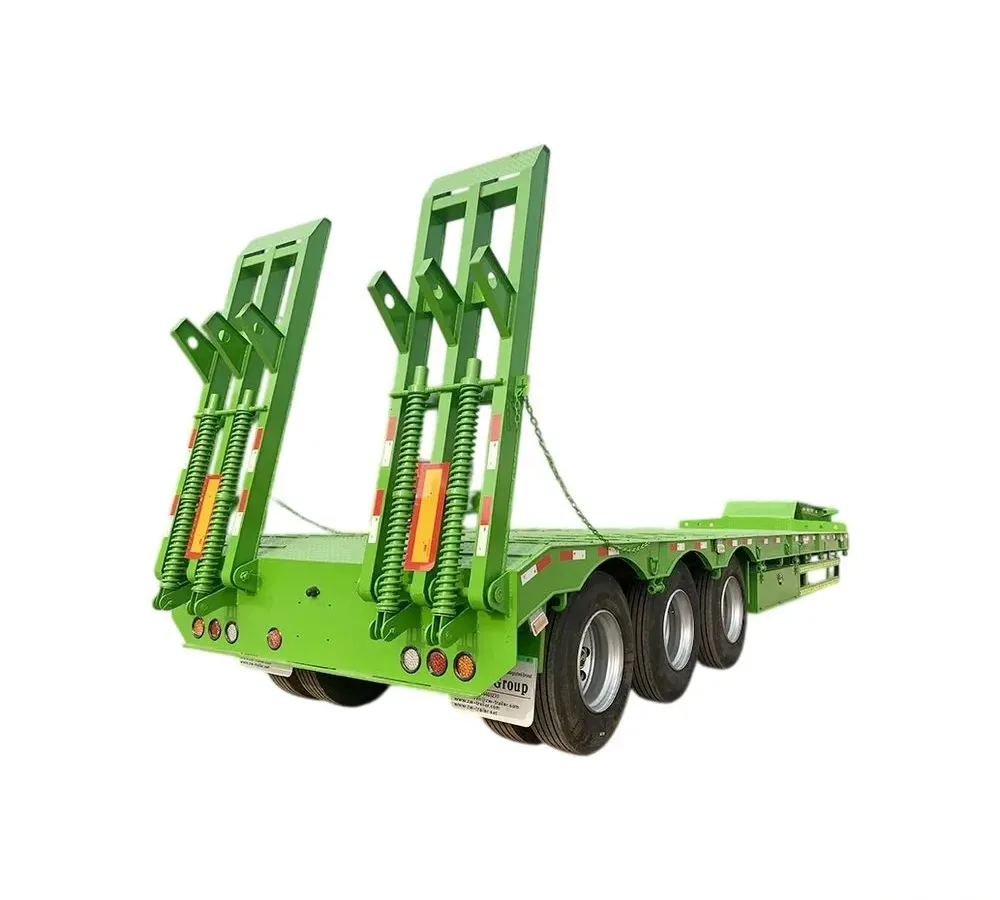
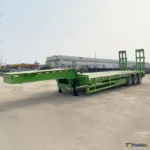
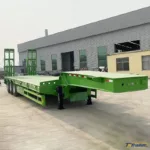
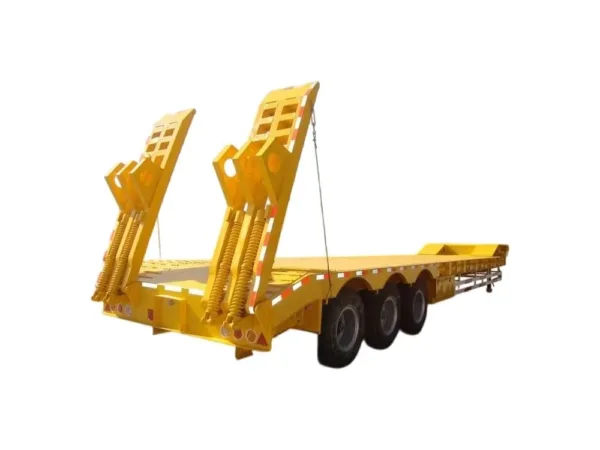
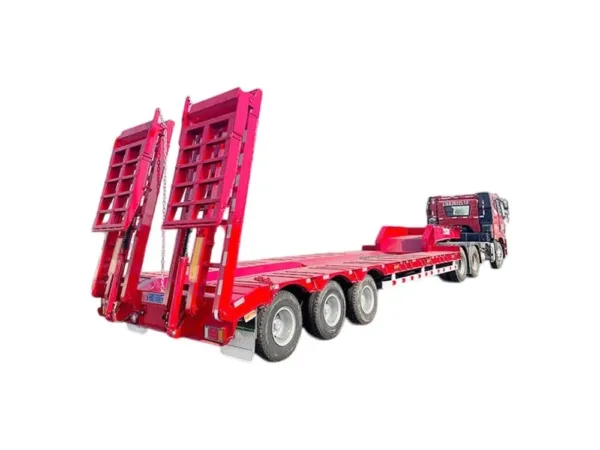
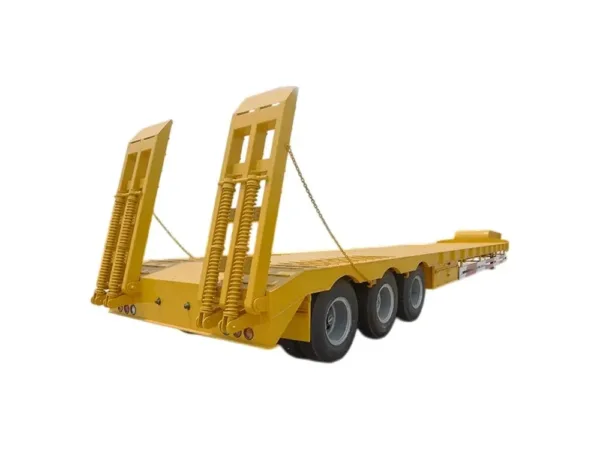
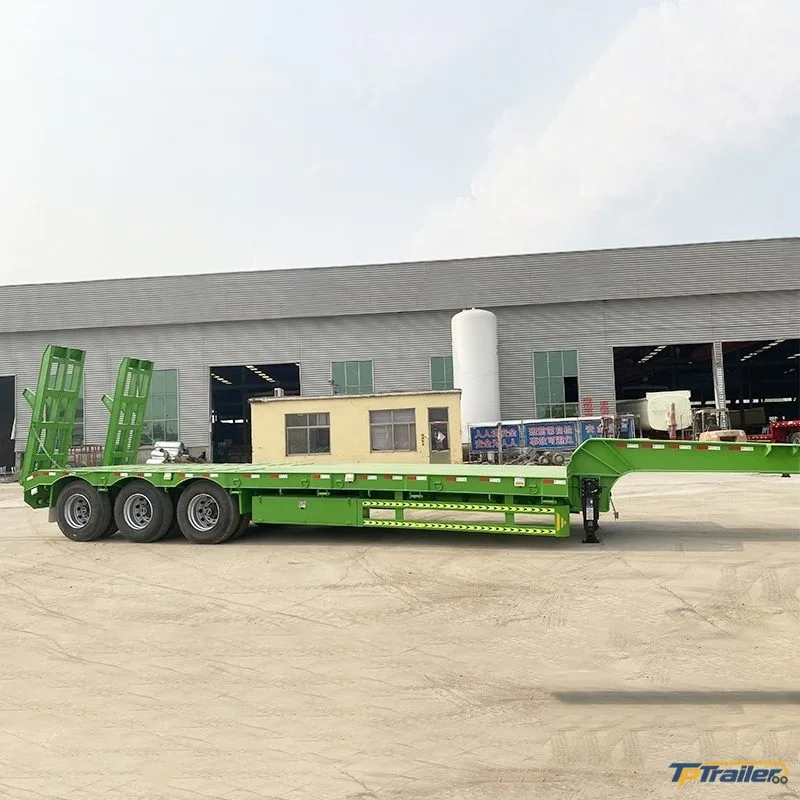
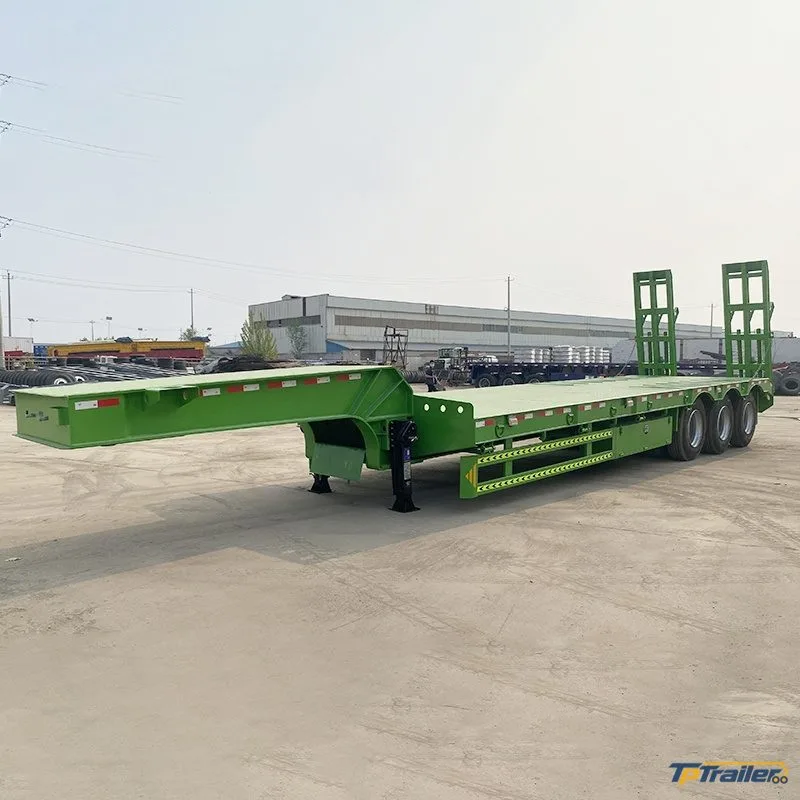
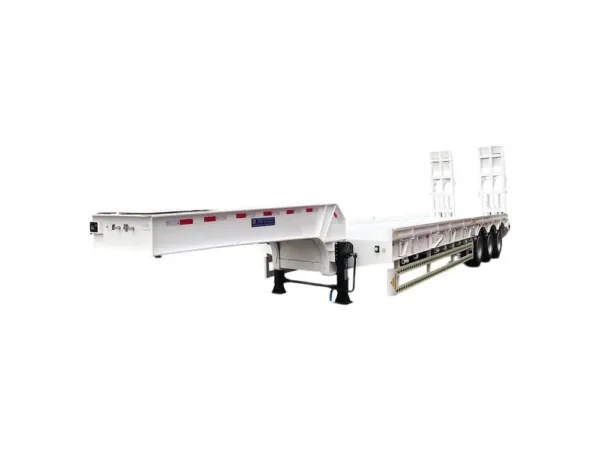
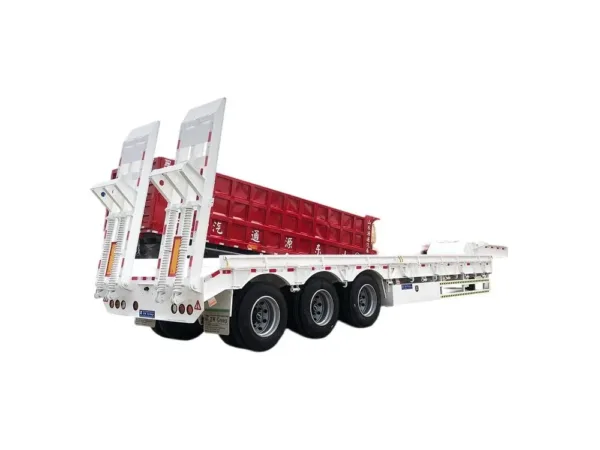
The Low bed Truck Trailer is the workhorse answer for operators moving loads that no standard flatbed will accept. This three-axle lowboy semi trailer is built around a high strength steel beam frame and a 60T load capacity, aimed at heavy haulage fleets, plant hire companies and construction logistics contractors. Its strongest argument is simple: a low deck height and a stiff beam frame let you carry tall, heavy and awkward cargo in one trip instead of splitting it. The trailer takes 12R22.5 tyres, a dual line brake system and either mechanical or air suspension, so it can be matched to the tractor unit and the roads it will actually run on.
Table of Contents
Why It Works On Site
Load capacity matched to real cargo. The rated 60T load capacity is the figure that decides which machines you can quote for. It covers excavators, wheel loaders and dozers in the mid-weight band without asking the operator to strip attachments first, so a Low bed Truck Trailer can be booked for a job on the strength of the machine weight alone rather than a site survey.
High strength steel beam frame. The beam construction is what keeps the deck straight under a concentrated load point, such as a track pad or a machine that sits over one axle group. That stiffness is why a heavy haulage Low bed Truck Trailer holds its line on long runs and does not need the load shuffled forward and back to spread weight.
Three axles for weight spread. Three axles share the cargo mass across more tyre contact points, which lowers the load per wheel and eases the pressure on the deck and the road surface. For an operator planning repeat trips with the same machine, a 3-axle Low bed Truck Trailer gives a predictable footprint that is easier to plan around than a shorter two-axle deck.
Low deck height and loading angle. The lowbed layout drops the cargo platform between the axles, cutting overall travel height and the ramp angle at the rear. Tall equipment clears overhead obstacles more easily, and machines with low ground clearance can be loaded without the steep climb a flatbed demands from a Low bed Truck Trailer.
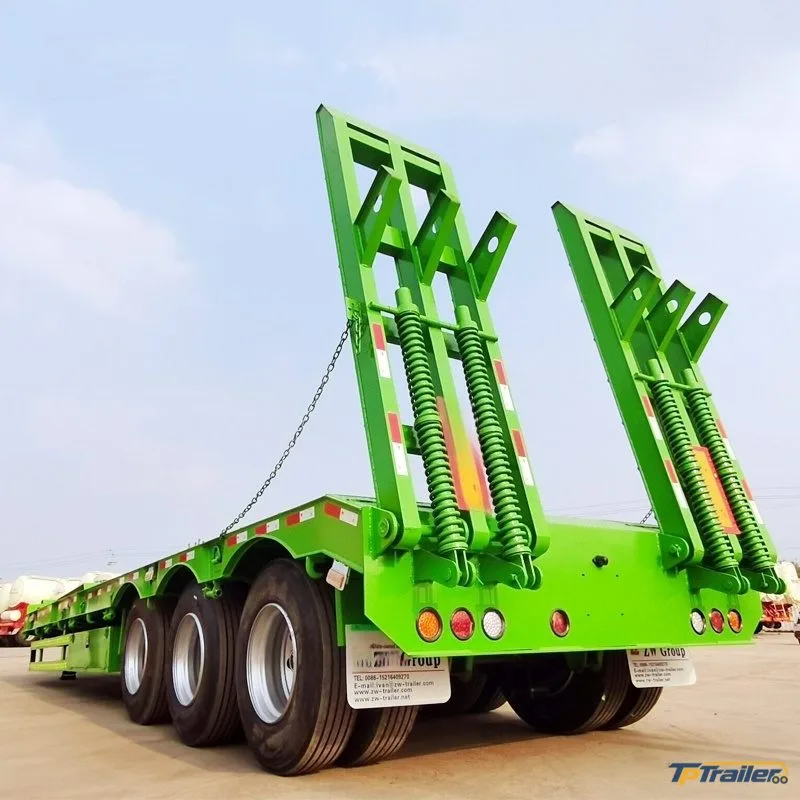
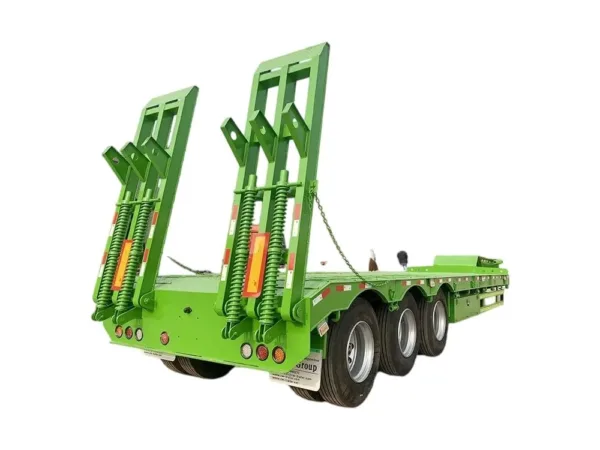
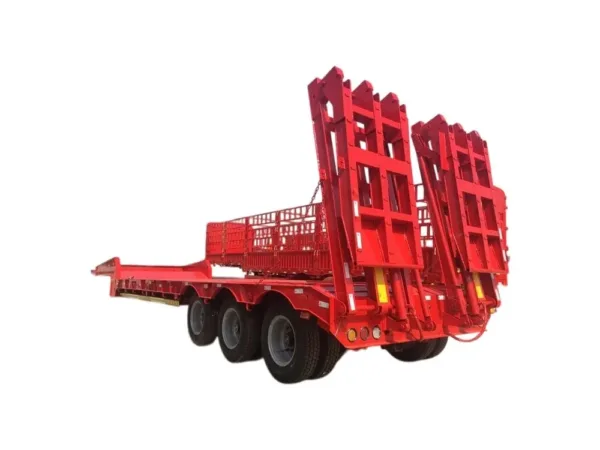
Manual or hydraulic ladder. The ladder choice decides how fast a machine goes on and off. A hydraulic ladder suits a fleet that loads several times a day and wants the ramp set from the cab area, while a manual ladder keeps the mechanism simple for operators who load once per shift and prefer fewer hydraulic parts to service on a Low bed Truck Trailer.
Suspension and brake options. Mechanical or air suspension and a dual line brake system let the trailer be specified to the tractor and the road class. Air suspension softens the ride for sensitive loads, mechanical suspension keeps maintenance straightforward, and the dual line brake layout gives the tow vehicle a familiar, serviceable connection on any Low bed Truck Trailer.
Where It Is Used
The most common duty is plant and construction equipment movement. A Low bed Truck Trailer carries excavators, backhoe loaders, bulldozers, rollers and graders between depots, quarries and active sites. Because the deck sits low, a machine with a long boom or a tall cab can often be driven on and transported without removal, which saves a mechanical team a disassembly and reassembly cycle at each end of the trip.
Site-to-site transfers on mixed road surfaces are routine work for this trailer, and the beam frame copes with the repeated loading of tracked machines that concentrate weight on a small area. Operators also use the same deck for skid steer units, mini plants and attachments moved as a group, treating the Low bed Truck Trailer as the general-purpose heavy asset in the fleet rather than a single-machine specialist.
A second workload is heavy and oversized cargo that will not sit on a standard flatbed. That includes steel structures, precast concrete units, industrial machinery, generator sets, transformers and long fabricated sections. The low platform keeps the combined height of trailer and cargo within normal travel limits, so a Low bed Truck Trailer can move tall items on ordinary routes rather than waiting for an abnormal load escort on every leg.
Wind turbine components, mining equipment and processing plant modules are typical of this category. For a fleet operator, the value is flexibility: the same trailer that hauls an excavator this week can carry a fabricated tank or a machine skid next week, which keeps utilisation high and avoids buying a second specialised unit for occasional oversized jobs that a Low bed Truck Trailer handles comfortably.
Choosing The Right Spec
Match load capacity to your heaviest routine cargo. Start from the machine or module you move most often, not the one you move once a year. A 60T load capacity covers a broad band of plant and industrial loads, so confirm your typical cargo sits inside it with margin for attachments and ballast. Choosing a Low bed Truck Trailer sized to routine work keeps the trailer productive instead of over-specified for everyday trips.
Pick the ladder type by loading frequency. Frequent loading and unloading in a shift points to the hydraulic ladder, which reduces manual handling and speeds up turnaround at each site. Where the trailer loads once a day or less, and the maintenance team prefers fewer hydraulic components, the manual ladder is the simpler match. Either way, the Low bed Truck Trailer is ordered with the ramp that fits your operating rhythm.
Choose suspension to suit the route and load. Mechanical suspension is the straightforward choice for rugged site access and mixed surfaces, where robustness matters more than ride quality. Air suspension is the better fit for sensitive machinery, long highway legs and loads that benefit from a softer ride. Both are available on the same Low bed Truck Trailer, so the decision follows the roads you run and the cargo you protect.
Confirm the coupling and support details. The king pin and support leg specification should be checked against your tractor unit and yard handling before ordering. A Low bed Truck Trailer is a long-term asset, so aligning the coupling, the support leg rating and the tyre set with the rest of the fleet avoids adapters and downtime later. Colour and finish are optional, which lets the unit match existing fleet livery without affecting the mechanical build.
Customisation Before Delivery
The axle count on your Low bed Truck Trailer is fixed at order confirmation. A three-axle layout suits the heavy haulage duty described here, while other axle counts can be discussed with the sales team. State your choice early so the beam, suspension and brake lines are matched to it. Nothing is built until the configuration is signed off.
Suspension type is another choice you settle before production. Mechanical suspension and air suspension are both offered on this Low bed Truck Trailer. Air suspension suits loads that need a softer ride, while mechanical suspension keeps the build simple. Tell us which you want at order confirmation, because the frame brackets differ between the two.
Tyres are supplied in the size listed for this Low bed Truck Trailer. Confirm the tyre specification you need when you place the order. The spare wheel provision is agreed at the same time, so the carrier leaves the yard with a complete set. Mixing tyre sizes later is not advised, as it changes the deck height.
The ladder can be manual or hydraulic. On a Low bed Truck Trailer used for frequent loading, the hydraulic ladder reduces operator effort. The manual type is lighter and has fewer parts to service. Choose at order confirmation, since the mounting points and hydraulic routing are set during fabrication and are hard to change afterwards.
Colour is optional on this Low bed Truck Trailer. You may specify a paint shade to match your fleet or your customer’s branding. Colour is recorded with the order so the finish is applied in one pass. Confirm it alongside the axle, suspension and ladder choices, because all of these are locked in at order confirmation.
Fitting And Installation
When the Low bed Truck Trailer arrives, the first job is matching the tractor unit to the trailer. Check the king pin size against your fifth wheel, and confirm the support leg mounting height clears the ground on your yard. The brake system is dual line, so the coupling heads and hose routing must match your tractor’s connections. Inspect the tyre set and the ladder fixings before the first load. A fitment drawing is confirmed at quotation, so the mounting points and hose routes are agreed before the trailer is built rather than improvised on arrival.
A mismatch at this stage is expensive. If the king pin or coupling does not suit your tractor, the Low bed Truck Trailer sits idle while adapters are sourced. Wrong hose routing can chafe and fail under load, which means downtime and a roadside repair. Check the suspension type against the load you plan to carry, and confirm the ladder operation before the first job. Because no fitment figures are stated here, treat the quotation drawing as the reference. Your workshop should compare it with the tractor before collection, not after.
Service Life And Maintenance
The tyres wear first on any Low bed Truck Trailer, especially on the axle that carries the steering load. Check tread depth and sidewall condition at each pre-trip inspection. Keep inflation even across the set, because uneven pressure shifts load onto fewer tyres. Rotate the set as wear appears. A matched tyre set protects the deck height and keeps the trailer tracking straight on long hauls.
Brake linings and the dual line system need regular attention. Inspect the lines for chafe and the couplings for seal condition. Test the brake response before every loaded trip. Because the Low bed Truck Trailer carries heavy loads, brake heat builds quickly on descents. Let the system cool rather than riding the brakes. Replace worn linings as a set, not one at a time, to keep braking balanced.
The suspension is a wear point on a Low bed Truck Trailer. On mechanical suspension, inspect the leaf springs, shackles and bushes for cracks or looseness. On air suspension, check the bags for cuts and the levelling valves for response. Look at the hangers and the beam ends for stress marks. Any knocking under load should be traced before the next job, not deferred.
The high strength steel beam carries the load, so inspect it for cracks at the welds and the cross-member joints. Clean the deck and check for corrosion where water sits. The paint finish is the first barrier, so touch up chips when you find them. Colour choice does not change the steel, but a clean, coated surface slows rust and extends the inspection interval between repairs.
The king pin, support legs and ladder are the fittings that see the most handling. Grease the king pin and check the support leg mechanism for smooth travel. On a hydraulic ladder, inspect the hoses and rams for leaks. On a manual ladder, check the pivot pins. These checks on your Low bed Truck Trailer are quick and prevent the small faults that stop a haul.
Packing And Container Loading
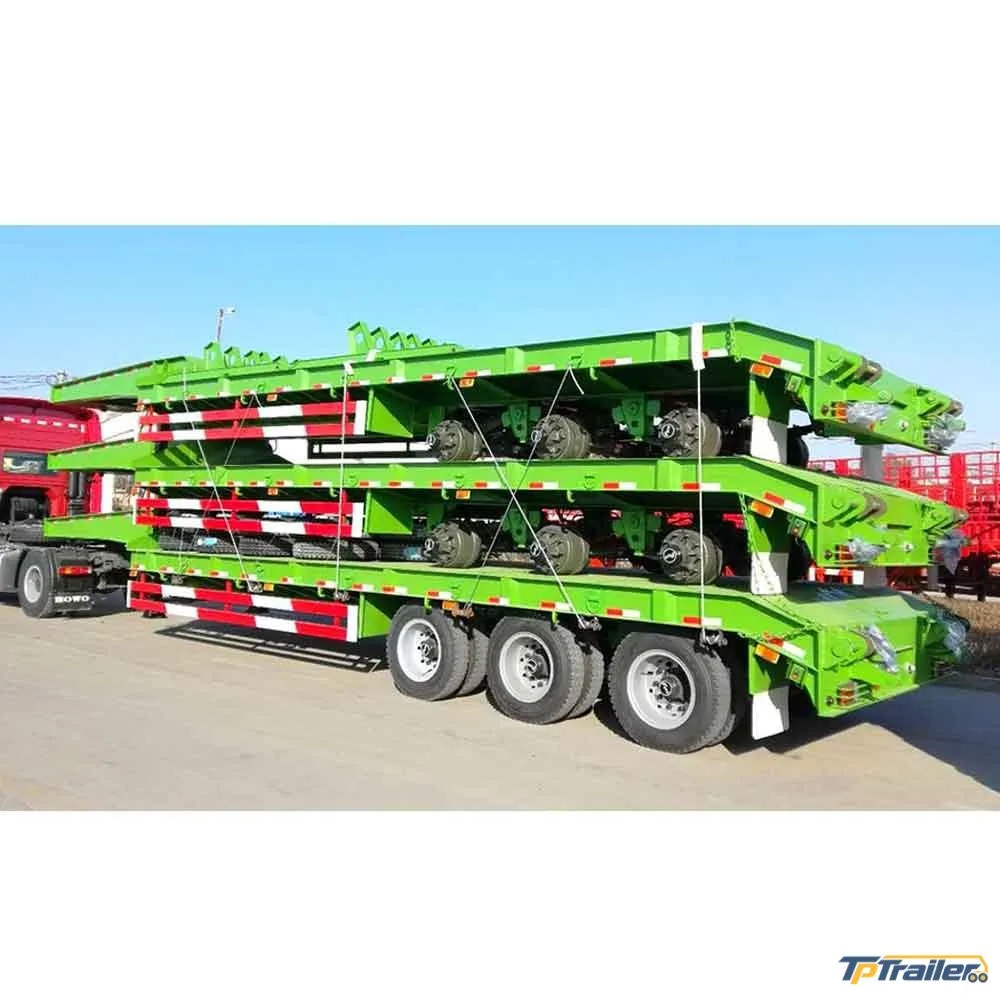
A Low bed Truck Trailer ships as a partly knocked-down unit. The main deck and side beams travel assembled, while the ramps, support legs and loose fittings are crated separately. Steel surfaces are cleaned and coated with a protective film before dispatch. Exposed machined areas such as the king pin and suspension mounts get a heavier coat of anti-rust compound. Small parts are boxed and strapped to the frame so nothing shifts during handling. Each unit is labelled with its position in the loading plan. The buyer should confirm the coating type and the crate marking format at quotation, because port handling in the destination country varies.
Loading depends on the deck length and the axle count. A Low bed Truck Trailer of this size is normally shipped in a flat rack or on a break-bulk vessel rather than inside a standard box. Ramps can be detached and laid flat to shorten the overall footprint. Nested loading of two units is sometimes possible but depends on deck width and axle spacing, so it must be planned before production. The buyer should ask for a loading drawing showing the centre of gravity, the lifting points and the lashing positions. Confirm the shipping method before the Low bed Truck Trailer is built, not after.
Common Mistakes Buyers Make
Matching the load rating to the wrong duty cycle. Buyers compare the headline capacity with their heaviest single lift and ignore repeated haulage. The trailer is rated for a load, not for an unlimited number of overloaded trips. Check the static rating against your daily payload profile, then confirm the axle and suspension combination supports that pattern with the supplier before ordering.
Ordering the wrong king pin size. The king pin must match the fifth wheel on the tractor that will actually pull the Low bed Truck Trailer. A mismatch means the trailer cannot be coupled at all. Measure the fifth wheel jaw opening and confirm the pin diameter and mounting height with the supplier, and state the tractor model in the enquiry so the fitment is checked before production.
Ignoring ramp type and approach angle. Manual and hydraulic ramps behave differently at the loading point. Buyers order the cheaper option and then find the ramp angle will not clear the equipment being loaded. Check the ramp length, the approach angle and the ground clearance of your cargo, then confirm which ramp type suits your site before the Low bed Truck Trailer is built.
Choosing suspension without checking the road. Mechanical and air suspension are not interchangeable for every route. Air suspension needs a reliable air supply and suits smoother roads, while mechanical suspension is simpler to maintain. State the road conditions and the average trip length, and confirm the suspension choice and its mounting arrangement with the supplier at quotation.
Skipping the brake and electrical check. The dual line brake system must match the tractor’s coupling and air pressure. Buyers discover incompatibility only at first hook-up. Ask for the brake line configuration and the electrical socket type in writing, and confirm the Low bed Truck Trailer will connect to your tractor without adapters before shipment.
Buyer Questions
How do I confirm the Low bed Truck Trailer will carry my heaviest machine?
Send the supplier the machine weight, the footprint and the centre of gravity, not just the total tonnage. Compare these against the load capacity and the deck length. Ask where the load should sit on the deck so the weight is spread across the axles. Confirm the ramp type can take the machine’s weight and approach angle. Get the deck loading position confirmed in writing before production starts, because deck reinforcement and axle spacing are fixed at build stage.
What should I check when the trailer arrives at the destination port?
Inspect the protective coating on the king pin, suspension mounts and deck surface before signing the delivery note. Check that crates are intact and that the ramp and support leg fittings are present against the packing list. Photograph any damage immediately. Confirm the tyre count and the axle configuration match the order. Then verify the brake lines and electrical socket against your tractor before the Low bed Truck Trailer leaves the port area, since corrections are harder once it is inland.
Can the trailer be shipped more cheaply by nesting two units?
Nesting depends on deck width, axle spacing and ramp design, so it cannot be assumed. Ask for a loading drawing that shows whether two Low bed Truck Trailer units fit within the shipping space and how they are lashed. Confirm the shipping method, flat rack or break-bulk, and the lifting points. Freight cost and vessel space are confirmed at quotation, because they change with route and season. Decide the shipping method before production, not after.
Send your required deck length, the number of axles you need and your order quantity. State the tractor model and the cargo you haul so the king pin, ramp and suspension are checked against your operation. With those details, the Low bed Truck Trailer configuration and a quotation can be prepared without back-and-forth.
We use cookies to enhance your browsing experience, serve personalized content, and analyze our traffic. By clicking "Accept All", you consent to our use of cookies. Privacy Policy
Cookie Preferences
Required for the website to function properly. Cannot be disabled.
Help us understand how visitors interact with the website (Google Analytics).
Used to deliver personalized ads and measure ad campaign effectiveness.

















Write a Review