


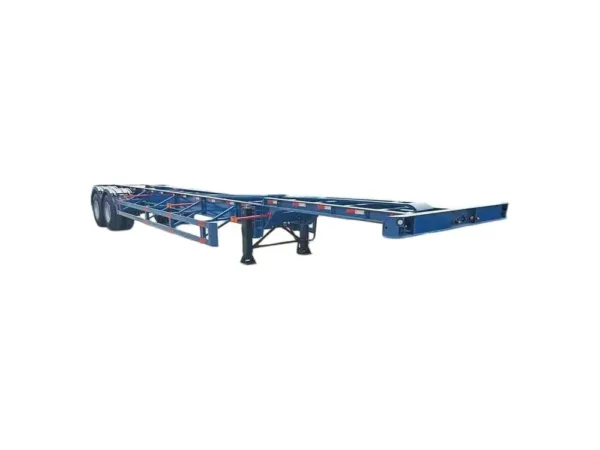
Container chassis built as a 3 axle 60 ton skeleton semi trailer with 12 ISO twist locks, 12R22.5 tires and 28 ton support legs. Request a quote today.
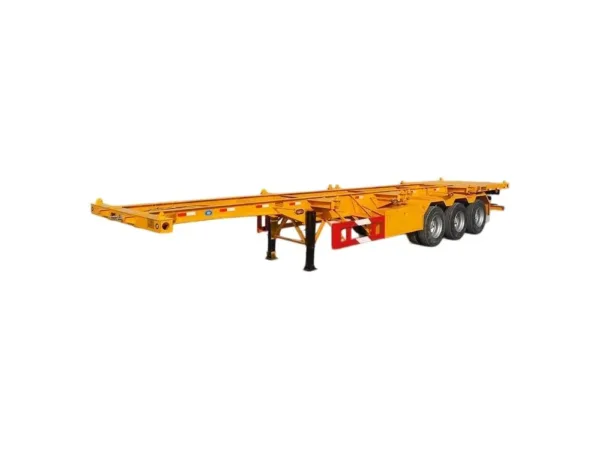


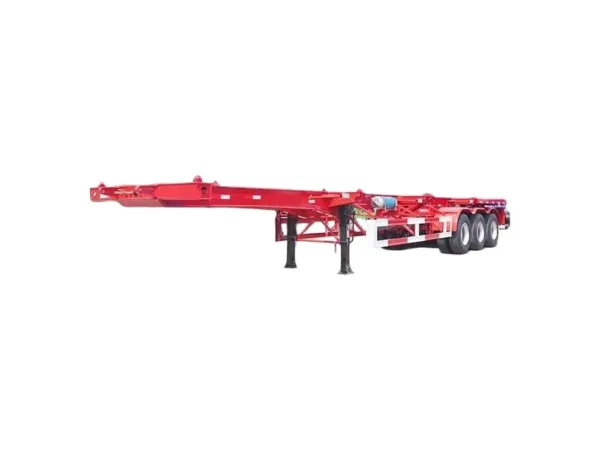
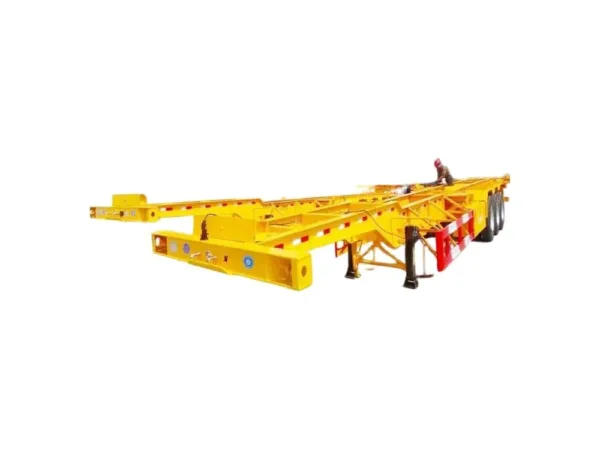
This container chassis is a skeleton semi trailer built to carry ISO containers on the road, and it is aimed at fleet operators, hauliers and traders who move boxes between ports, depots and warehouses. The frame is steel, the running gear is a three-axle arrangement, and the deck carries a set of ISO twist locks so a container sits down and locks in one pass.
The strongest reason to choose it is the combination of a rated support leg set and a removable king pin, which lets one container chassis work as a tractor-hauled unit and still stand loaded between trips. Buyers comparing a container chassis for sale against a flatbed usually want that dedicated lock pattern and a lower deck height, and this unit delivers both without extra conversion work.
The most common job for a container chassis is the port-to-depot run. A tractor collects a loaded box at a terminal gate, the trailer carries it on public roads to a warehouse or railhead, and the same unit returns with an empty. Because the deck is a skeleton frame rather than a full flatbed, the box sits low and the centre of gravity stays reasonable for a loaded run.

Fleets on this duty like the twist lock pattern because it removes any guesswork at the gate, and they like the support legs because a trailer can be dropped at a shunting yard while the tractor takes another load. On a busy container chassis, the round trip is short and repeated, so fast locking and reliable brakes matter more than payload flexibility.
A second use is the container delivery trailer for sale buyer who serves inland customers. Here the trailer may run between a depot and a construction site, a factory or a distribution centre, often on mixed roads and with waiting time at each end. The three-axle layout and spring package suit that duty, and the tyre fitment is easy to source on the road.
Where the cargo is a single box, the lock pattern holds it in place; where the operator needs to move different box lengths over a week, the lock count can be set to match. This is also the pattern used for hauling boxes between rail terminals and road depots, where a container chassis spends part of its life standing loaded on its legs between train arrivals.
A third pattern is the 40ft container semi trailer used as a dedicated shuttle between two fixed points, such as a port terminal and a nearby empty-park. On that duty the trailer never waits for a load, so the value of the container chassis sits in cycle time: how quickly a box locks down, how surely the brakes hold on a slope at the gate, and how little the driver has to leave the cab to check.
Fixed-lane operators also tend to standardise the tyre and colour across the fleet, because a uniform set of units can be swapped between tractors without anyone checking the paperwork. Where the same box length runs every day, the standard lock pattern is enough and the trailer earns its keep on repetition rather than flexibility.
A container chassis arrives as a complete running unit, so fitting work is mostly about matching it to the tractor and to the containers you already own. The king pin is the first check. Confirm the tractor fifth wheel couples cleanly and that the pin height suits your coupling plate. The removable king pin is a standard item, and the coupling position is agreed before the build.


Next, check the twist locks against your container corner castings. Lock spacing is set to the pattern confirmed at order, so a container that does not sit square points to a mismatch in the order, not to a fault in the trailer. Walk the frame with a tape before the first load and record what you find.
Brake and electrical connections are the second area. The braking system uses spring brake chambers and an air tank, and the lines must be routed clear of the landing legs and any sliding contact points. Match the coupling head to your tractor’s service and emergency lines, then check for chafing along the full run.
Tyres and axle alignment deserve a check on arrival, because a container chassis that has travelled far can settle in transit. If your input pack does not list a torque value, do not guess one; a fitment drawing and the coupling details are confirmed at quotation, and your workshop should work from that sheet. A wrong coupling height or a mismatched lock pattern costs days of downtime while parts are reordered.
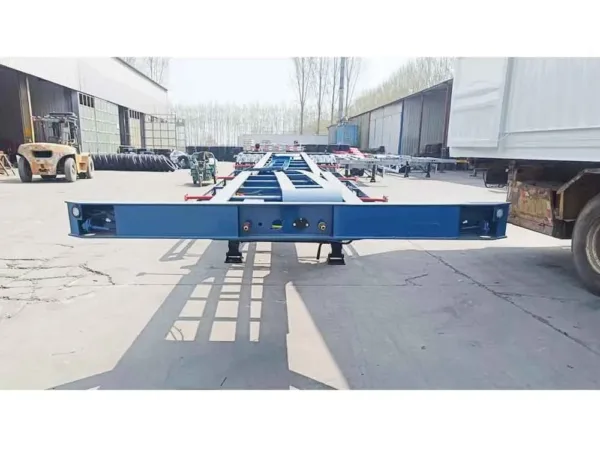
Each container chassis leaves the yard as a bare skeleton frame with the running gear fitted. Steel surfaces are cleaned and coated before dispatch. The ISO twist locks, the removable king pin and the support legs are the parts most exposed in transit, so they travel protected rather than bare. Confirm with the supplier which coating system is applied and how the twist lock heads are wrapped. Ask for loading photos taken at the yard. A container chassis is a long, low frame, and the way it is blocked inside the container decides whether the coating arrives intact.
The frame is not a nesting part. Its length and its axle set mean one unit per platform or one unit per container, depending on the shipping method chosen. Ask the supplier to confirm the packed dimensions and the loaded weight before you book freight. Stacking frames on top of each other is not something to assume. On arrival, check the twist locks for free movement, inspect the king pin area for deformation, and verify the support legs raise and lock. Photograph any coating damage before unloading.
The input lists twelve ISO twist locks as standard, with the count adjustable to your needs. Send the supplier the container lengths you plan to carry and the lock positions you require. Ask for a simple drawing showing where each lock sits on the frame. Confirm whether the change affects the price or the build schedule. Get the approved layout in writing before production, because a container chassis built to the wrong lock pattern cannot be corrected at destination.
Confirm the axle weight load, the tire type, the number of tires and the leaf spring set count against your intended payload. Ask how the braking system is configured, including the spring brake chamber and the air tank. Check that the support legs suit the loads you will put on them during loading and parking. Put every one of these on the quotation and have the supplier return it signed, so the container chassis matches your fleet.
The listed price range covers a single unit at the higher end and drops at larger volumes. The lower tier applies from the stated larger quantity. Ask the supplier to quote your exact quantity and to state which tier it falls into. Confirm what is included in the unit price, such as the twist lock count and the tire choice, since options can move the figure. Freight and destination charges are separate and confirmed at quotation.
Treat the rating in the title as the headline load class for the assembly, and check it against the axle weight load and the number of axles fitted. The axle figure is the one your workshop and your transport inspector will work from, so ask the supplier to state both on the quotation. Then compare the pair against your heaviest legal payload on the routes you serve. A container chassis that is rated well above your real loads leaves margin for uneven box weights, but the legal limit on the road is set by the axles, not by the headline number.
Start with the parts that wear on any container chassis: twist lock heads and pins, leaf spring bushes, brake chambers and the leg gearing. Because the tyre fitment and lock count are agreed at order, hold a small stock of the exact items you specified rather than a generic kit. Ask the supplier for the part references that match your build sheet and keep them with the unit’s paperwork. A fleet that standardises the lock count, tyre and colour across every container chassis can carry one spares set for the whole group.
To receive a quotation for a container chassis, send the overall length you need, the number of axles, and the quantity you plan to order. Add your container sizes and any tire or color preference. The supplier will confirm the specification and the price tier that applies to your volume. If you run a mixed fleet, say so at this stage, because the lock pattern and tyre choice on each container chassis are easier to align before the build sheet is signed than after the units are on the water.
Explore more container chassis in this range.
| Dimensions | 50 × 50 × 50 | ||
|---|---|---|---|


No reviews yet — click the Review button on the right to share your experience with this product.









Fill in the form below and our team will respond within 24 hours.
Write a Review